


How to Prepare for Your G2 Driving Lessons
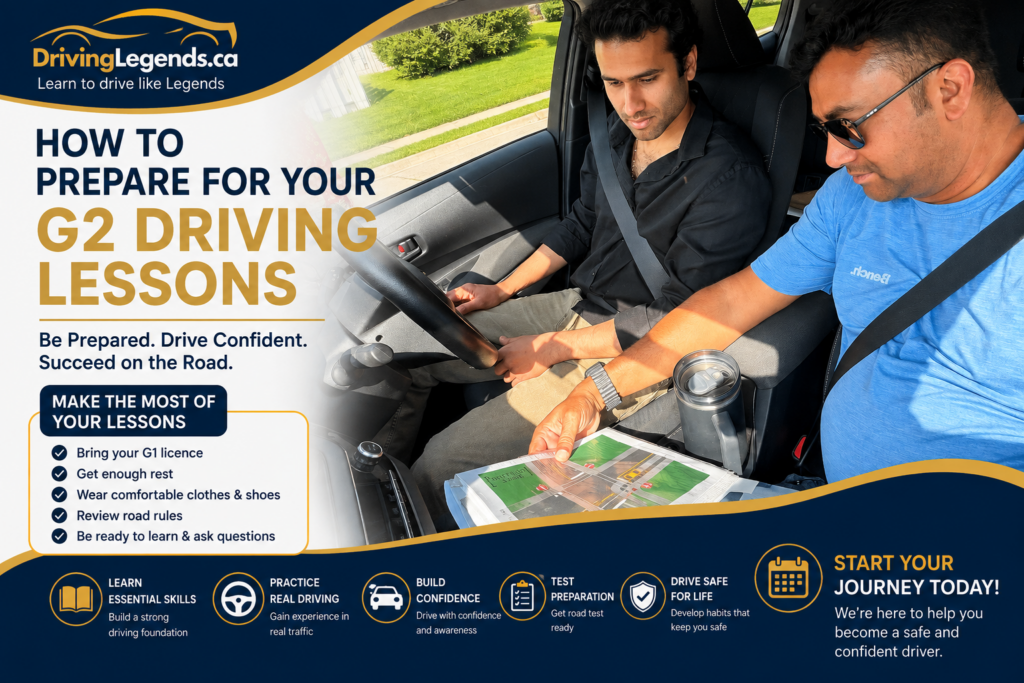
Starting your G2 driving lessons is an exciting step toward becoming an independent driver in Ontario. After earning your G1 licence, you’re ready to gain practical experience and learn how to handle real-world driving situations. However, getting the most out of your lessons requires more than simply sitting behind the wheel. Proper preparation can help you feel more comfortable, learn faster, and build good driving habits from the beginning. Whether you’re a complete beginner or you’ve already had some practice with a family member or friend, knowing what to expect can make your G2 Driving Lessons more productive. In this guide, we’ll explain how to prepare for your lessons, what to bring, what skills you should focus on, and how to make steady progress toward your G2 road test. What Are G2 Driving Lessons? G2 driving lessons are practical training sessions designed to help G1 drivers develop the skills needed to drive safely and confidently. During professional lessons, an instructor can teach and evaluate important skills such as: Vehicle control Steering Starting and stopping Turns Lane changes Mirror and shoulder checks Parking Three-point turns Intersections Speed management Defensive driving Road test preparation Lessons are usually adjusted according to your experience and individual learning needs. A beginner may spend more time learning basic vehicle control, while a more experienced learner may focus on correcting specific habits and preparing for the G2 road test. 1. Bring Your G1 Licence Before your lesson, make sure you have your valid G1 licence with you. Your instructor may need to confirm that you’re legally permitted to participate in the lesson. Keeping your licence with you also prevents unnecessary delays. It’s a simple step, but checking your documents before leaving home can make your lesson start smoothly. 2. Get Enough Rest Before Your Lesson Driving requires concentration, observation, and quick decision-making. Avoid arriving for a lesson when you’re extremely tired or distracted. Getting enough sleep beforehand can help you: Concentrate better React more quickly Remember instructions Stay calm in traffic Make better decisions Your physical and mental condition can affect how effectively you learn. 3. Wear Comfortable Clothing and Shoes Choose clothing that allows you to move comfortably and footwear that provides good pedal control. Avoid shoes that make it difficult to feel the accelerator or brake. Comfortable clothing and appropriate footwear can help you focus on driving instead of adjusting your clothes or worrying about your feet. 4. Review Basic Ontario Road Rules You don’t need to memorize everything before your first lesson, but reviewing basic road rules can give you a strong starting point. Before your lessons, review: Stop signs Yield signs Traffic lights Speed limits Right-of-way rules School zones Pedestrian crossings Lane markings Parking restrictions Understanding the rules makes it easier to focus on practical driving skills when you’re behind the wheel. 5. Know What You Want to Improve Before your lesson starts, think about areas where you feel less confident. For example, you might be uncomfortable with: Parallel parking Changing lanes Busy intersections Highway driving Left turns Reverse parking Driving in heavy traffic Tell your instructor about these concerns. Professional instruction becomes more useful when your instructor understands where you need additional practice. 6. Don’t Worry About Making Mistakes One of the biggest mistakes new drivers make is worrying too much about making mistakes. Remember that driving lessons are for learning. You may: Forget a shoulder check Turn too wide Brake too quickly Misjudge a parking maneuver Become nervous at an intersection That’s completely normal. Instead of becoming frustrated, listen to your instructor’s feedback and try the skill again. Repetition is one of the best ways to develop good driving habits. 7. Learn Proper Mirror and Shoulder Checks Observation is one of the most important parts of safe driving. Before and during your G2 driving lessons, start developing the habit of regularly checking: Rear-view mirror Side mirrors Blind spots Shoulder checks are particularly important when changing lanes or making certain movements around other vehicles. Don’t treat observation as something you only do during the road test. Make it part of your everyday driving routine. 8. Practice Basic Vehicle Control Before moving into complicated traffic situations, make sure you’re becoming comfortable controlling the vehicle. Important skills include: Smooth Acceleration Avoid pressing the accelerator too aggressively. Controlled Braking Practice stopping smoothly while maintaining a safe distance. Steering Keep the vehicle properly positioned within your lane. Speed Control Learn to maintain an appropriate speed without constantly accelerating and braking. Strong vehicle control provides the foundation for more advanced driving skills. 9. Prepare to Learn Parking Skills Parking can be challenging for new drivers, so don’t be discouraged if it takes several attempts to feel comfortable. Your lessons may include: Parallel parking Reverse parking Angle parking Hill parking Pulling into and out of parking spaces Instead of trying to memorize every movement, focus on understanding the positioning of the vehicle and developing good observation habits. With repeated practice, parking becomes much more natural. 10. Practice Turns and Intersections Intersections require drivers to make several decisions at once. During your lessons, you’ll learn how to: Approach intersections safely Position your vehicle correctly Signal appropriately Check for pedestrians Observe traffic signs and signals Yield when required Complete left and right turns safely Your instructor can gradually introduce more complicated intersections as your confidence improves. 11. Be Ready to Learn Lane Changes Lane changes are an important part of everyday driving and G2 road test preparation. A safe lane change generally involves: Mirror → Signal → Shoulder Check → Safe Gap → Smooth Movement Your instructor will help you develop this routine until it becomes a natural part of your driving. Avoid rushing a lane change. If there isn’t a safe gap, wait for one. 12. Ask Questions During Your Lessons Don’t be afraid to ask your instructor questions. For example: Why should I position the vehicle this way? When should I check my blind spot? How can I improve my parallel parking? When should I start slowing
What Is Included in G2 Driving Lessons?
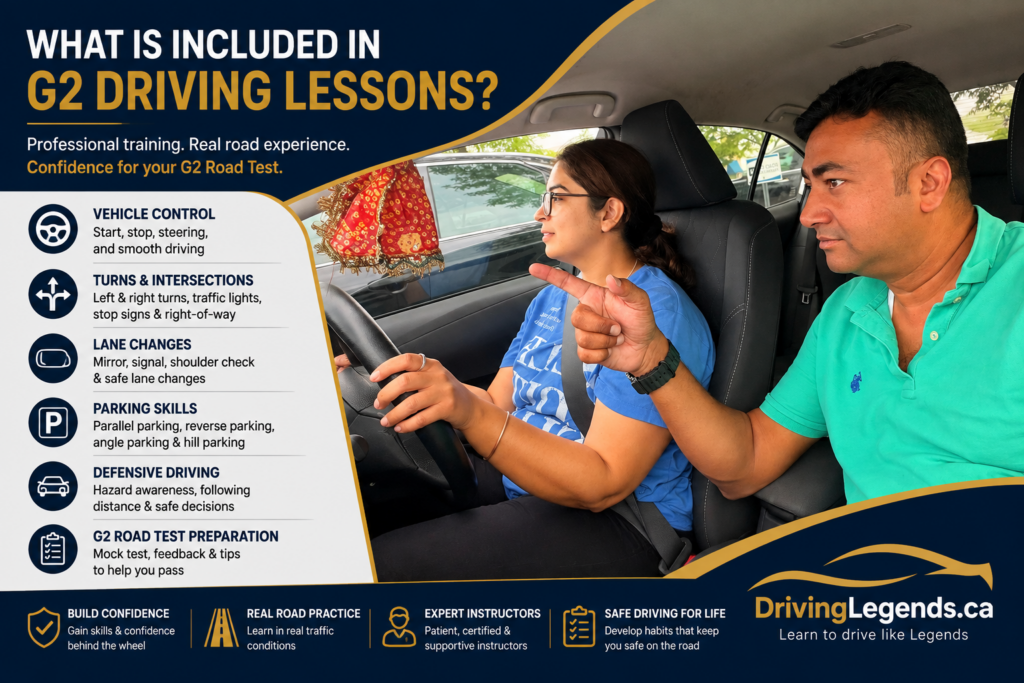
Getting your G2 licence is an important step toward becoming an independent driver in Ontario. While passing the G1 knowledge test gives you permission to begin driving with the appropriate restrictions, the next stage is developing the practical skills needed to drive safely and confidently on your own. This is where G2 Driving Lessons can make a significant difference. Professional driving lessons give you the opportunity to practice essential skills with an experienced instructor who can identify mistakes, explain proper techniques, and help you become comfortable in different traffic situations. But what exactly is included in G2 driving lessons? In this guide, we’ll explain the major skills and areas typically covered during professional G2 driving lessons and how this training can help you prepare for your G2 road test. What Are G2 Driving Lessons? G2 driving lessons are practical, behind-the-wheel training sessions designed to help beginner drivers develop the skills required for safe everyday driving and G2 road test preparation. Lessons are generally personalized according to the student’s experience. A complete beginner may spend more time learning vehicle control and basic road skills, while an experienced G1 driver may focus more heavily on parking, lane changes, traffic situations, and test preparation. The goal is not simply to teach you how to pass a road test. Good driving instruction helps you develop habits that remain useful long after you receive your G2 licence. 1. Vehicle Controls and Basic Car Operation One of the first things you’ll learn is how to properly operate the vehicle. Your instructor can help you become familiar with: Adjusting your seat and mirrors Using the steering wheel correctly Understanding dashboard controls Using turn signals Operating windshield wipers and lights Controlling the accelerator and brake Maintaining a comfortable driving position Understanding the vehicle before entering busy traffic can make the learning process much less stressful. 2. Starting, Stopping and Smooth Vehicle Control Smooth vehicle control is a foundation of good driving. During your lessons, you’ll practice: Starting safely Accelerating smoothly Braking gradually Coming to complete stops Maintaining control at low speeds Maintaining a consistent position within your lane New drivers sometimes press the accelerator or brake too aggressively. With practice and instructor feedback, you can learn to make these actions smoother and more predictable. 3. Steering and Lane Positioning Correct steering technique helps you maintain control and stay properly positioned on the road. Your instructor may work with you on: Steering smoothly through curves Maintaining your lane Making controlled turns Correcting your position when necessary Looking ahead rather than focusing only on the vehicle immediately in front of you Proper lane positioning becomes especially important as you begin driving on busier roads. 4. Left and Right Turns Turning may seem simple, but there are several things a driver needs to consider before completing a turn. G2 driving lessons can cover: Proper signaling Checking mirrors Checking for pedestrians and cyclists Selecting the correct lane Controlling your speed Positioning the vehicle correctly Completing the turn safely Repeated practice helps make these steps more natural. 5. Intersections and Right-of-Way Intersections require constant observation and good decision-making. You’ll learn how to approach and navigate: Stop signs Yield signs Traffic lights Uncontrolled intersections Left-turn situations Pedestrian crossings Busy urban intersections Your instructor can also explain right-of-way rules and help you understand when you should proceed and when you should wait. 6. Lane Changes Safe lane changes require more than simply turning on your signal. A proper lane change generally involves: Checking your mirrors. Signaling your intention. Checking your blind spot. Confirming there is a safe gap. Moving smoothly into the new lane. Cancelling the signal when appropriate. Your instructor will help you develop a consistent observation routine so that these actions become habits. 7. Blind Spot and Shoulder Checks Blind spot awareness is one of the most important skills for new drivers. Mirrors cannot show you everything around your vehicle. That’s why drivers need to check their blind spots before certain movements. You may practice shoulder checks when: Changing lanes Merging Moving away from the curb Preparing for certain turns Entering or leaving traffic Developing consistent observation habits is essential for both the G2 road test and everyday driving. 8. Parking Skills Parking is a major part of learning to drive independently. Depending on your needs, G2 Driving Lessons may include practice with: Parallel Parking Learning how to position and maneuver your vehicle into a space beside the curb. Reverse Parking Practicing how to safely reverse into a parking space while maintaining control and awareness. Angle Parking Learning how to enter and exit angled parking spaces safely. Hill Parking Understanding how to position your vehicle properly when parking on an incline or decline. Parking becomes much easier once you understand the reference points and develop consistent steering control. 9. Three-Point Turns A three-point turn allows a driver to change direction when there isn’t enough space to make a normal turn. During practice, you’ll learn to: Check your surroundings Signal appropriately Control the vehicle at low speed Reverse safely Watch for other road users The focus is on completing the maneuver safely rather than rushing through it. 10. Speed Management Maintaining the appropriate speed is an important part of safe driving. Your instructor will help you understand how to: Follow posted speed limits Adjust speed before turns Slow down when approaching hazards Maintain a safe speed in residential areas Adapt to traffic and road conditions Driving at an appropriate speed gives you more time to recognize and respond to hazards. 11. Defensive Driving One of the biggest benefits of professional driving lessons is learning defensive driving. Defensive driving means actively looking for potential hazards instead of assuming that other road users will always make the correct decision. You’ll learn techniques such as: Maintaining a safe following distance Scanning ahead Watching surrounding traffic Anticipating possible hazards Avoiding distractions Adjusting your driving to road conditions These skills can help you become a safer driver well beyond your G2 road test. 12. Driving Around Pedestrians and
How to Renew Your Ontario Driver’s Licence
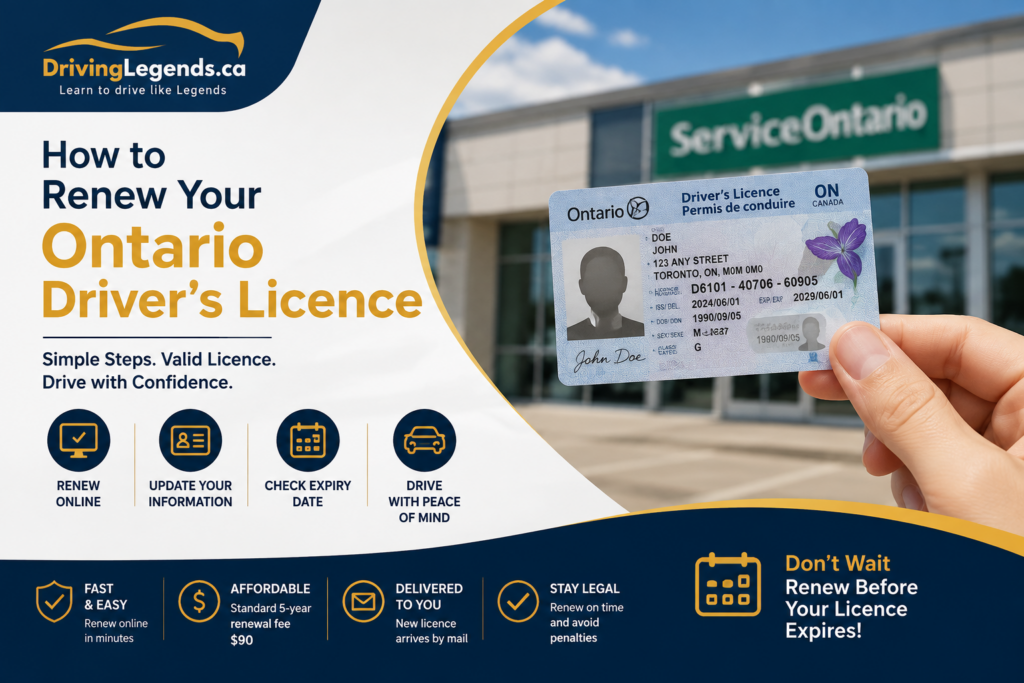
Your Ontario driver’s licence is one of the most important documents you carry. Whether you use your vehicle for commuting, work, or everyday errands, maintaining a valid driver’s licence is essential for legally driving in Ontario. Many drivers wait until the last minute to renew their licence, only to discover they need additional documents, a new photo, or an in-person visit. Understanding the renewal process ahead of time can help you avoid unnecessary stress and ensure your driving privileges remain valid. In this guide, we’ll explain everything you need to know about renewing your Ontario driver’s licence, including eligibility requirements, fees, renewal methods, and helpful tips for a smooth renewal process. When Do You Need to Renew Your Ontario Driver’s Licence? Ontario driver’s licences are generally valid for five years and must be renewed before their expiration date. Most licences expire on the driver’s birthday. Driving with an expired licence can lead to fines and other complications, so it’s important to renew on time. Drivers can typically renew: Online (if eligible) In person at a ServiceOntario centre Under special procedures if they are outside Ontario during the renewal period How to Check Your Licence Expiry Date You can find your expiry date on the front of your driver’s licence card. It’s a good idea to check your licence periodically and set reminders before the expiry date arrives. Ontario also offers renewal reminder services through email, text message, or phone notifications. Can You Renew Your Ontario Driver’s Licence Online? Many Ontario drivers are eligible to renew their licence online through ServiceOntario. Generally, you may renew online if: You hold a valid full G, M, or GM licence. Your licence is not suspended or cancelled. You do not require a vision, written, or road test. You do not have new medical conditions affecting your ability to drive. You do not have outstanding fines or penalties. You have not recently changed your address. For online renewal, you’ll typically need: Driver’s licence number 7-digit Trillium number from the back of your licence Postal code Payment method (Visa or Mastercard) Renewing Your Licence Online: Step-by-Step Step 1: Visit the Official Renewal Portal You can start the renewal process through the official Ontario government renewal service. Ontario Driver’s Licence Renewal Portal Step 2: Enter Your Information Provide: Driver’s licence number Trillium number Postal code Step 3: Confirm Eligibility The system will verify whether you qualify for online renewal. Step 4: Pay the Renewal Fee Most standard renewals can be paid online using a credit card. Step 5: Receive Confirmation Once approved, you’ll receive confirmation and, in some cases, a temporary validation document if your licence is near expiry. How Much Does It Cost to Renew an Ontario Driver’s Licence? The standard fee for a five-year driver’s licence renewal is generally $90. In some situations, fees may differ if your renewal period is shorter or aligned with another government-issued card. Always check current fees during the renewal process, as government fees may change over time. When Must You Renew In Person? Some drivers are required to visit a ServiceOntario centre rather than renewing online. You may need to renew in person if: A new photo is required. Your licence has been suspended. You need a vision test. You need a medical review. Your licence has been expired for an extended period. You recently changed personal information. During your visit, staff may: Verify your identity Update your photo Review medical requirements Collect renewal fees What Documents Do You Need? Requirements can vary depending on your situation, but drivers may need: Current driver’s licence Government-issued identification Proof of address (if required) Payment method If you’re renewing in person, bring all requested documents to avoid delays. How Long Does It Take to Receive Your New Licence? After renewal, your new driver’s licence card is typically mailed within 4 to 6 weeks. If your licence expires before the new card arrives, you may receive a temporary validation document that allows you to continue driving legally while waiting for the permanent card. What Happens If Your Licence Expires? If your licence expires, you should renew it as soon as possible. Consequences of driving with an expired licence may include: Traffic fines Insurance complications Legal penalties Difficulty completing vehicle-related transactions The longer a licence remains expired, the more renewal requirements may apply. Renewing Your Licence While Outside Ontario If you’re travelling, working, or temporarily living outside Ontario when your licence is due to expire, special renewal options may be available. Ontario allows eligible drivers outside the province to request temporary licence extensions or renewal assistance. For more information: Renew a Driver’s Licence Outside Ontario Common Mistakes to Avoid During Renewal Waiting Until the Last Minute Start the renewal process well before your expiry date. Not Checking Your Eligibility Some drivers assume they qualify for online renewal when an in-person visit is required. Entering Incorrect Information Double-check: Licence number Trillium number Postal code Incorrect information may delay your application. Forgetting to Update Your Address Your driver’s licence information should always be current. Tips for Keeping Your Licence Valid To avoid renewal problems in the future: Check your expiry date annually. Sign up for renewal reminders. Update your address promptly. Keep your licence in good condition. Renew early when possible. Staying proactive helps prevent interruptions to your driving privileges. Why Safe Driving Matters Beyond Licence Renewal Renewing your licence keeps you legally authorized to drive, but maintaining strong driving skills is equally important. Whether you’re a new driver, preparing for your G2 or G test, or simply looking to improve your confidence on the road, professional driving instruction can help you stay safe and up to date with Ontario driving standards. At Driving Legends, we believe lifelong learning contributes to safer roads and more confident drivers. Final Thoughts Renewing your Ontario driver’s licence is a straightforward process when you understand the requirements and prepare ahead of time. Whether you renew online or visit a ServiceOntario centre, staying aware of your expiry date and completing
What You’ll Learn in a BDE Driving Course

Learning to drive is an exciting milestone, but becoming a safe and confident driver requires more than simply knowing how to operate a vehicle. That’s where a BDE Driving Course comes in. Approved by Ontario’s Ministry of Transportation (MTO), a Beginner Driver Education (BDE) course is designed to teach new drivers the essential knowledge, skills, and habits needed for safe driving. Whether you’re a new driver, a teenager preparing for your first licence, or a newcomer to Canada learning Ontario’s road rules, a BDE Course provides structured training that helps build confidence behind the wheel while preparing you for real-world driving situations. In this article, we’ll explore everything you’ll learn in a BDE Driving Course and how it can help you become a safer, more responsible driver. What Is a BDE Driving Course? A BDE Driving Course (Beginner Driver Education Course) is a comprehensive driver training program approved by the Ontario Ministry of Transportation. The course combines: Online or classroom instruction Home-study learning Practical in-car training Defensive driving education Road safety awareness The goal is to help new drivers develop the knowledge and practical skills necessary for safe driving while preparing for the G2 road test. Completing an approved BDE Course may also help reduce insurance costs and allow eligible drivers to book their G2 road test sooner. Why Take a BDE Course? Many new drivers learn from family or friends, but professional driver education offers significant advantages. Benefits include: Learning from certified instructors Building safe driving habits Understanding Ontario traffic laws Developing defensive driving skills Gaining confidence behind the wheel Improving road test success rates Becoming a safer and more responsible driver A structured learning environment helps ensure that important driving skills are taught correctly from the beginning. Components of a BDE Driving Course An approved BDE Driving Course typically includes three main learning components: 1. Online or Classroom Learning The theoretical portion of the course focuses on road safety, traffic laws, and driver responsibilities. Students learn: Ontario traffic laws Road signs and signals Rules of the road Right-of-way regulations Safe driving practices Collision prevention techniques This knowledge forms the foundation of safe driving. 2. Home Study Learning Home-study modules allow students to review important concepts independently. Topics often include: Hazard perception Risk management Vehicle safety Driver responsibility Decision-making skills These lessons reinforce the information learned during formal instruction. 3. In-Car Training Practical driving experience is one of the most valuable parts of a BDE Driving Course. Students receive one-on-one instruction from certified driving instructors who guide them through real-world driving situations. What You’ll Learn During In-Car Training Vehicle Familiarization Before driving, students learn how to properly operate a vehicle. This includes: Adjusting mirrors Proper seat positioning Dashboard controls Steering wheel adjustment Vehicle safety features Understanding vehicle controls helps drivers feel more comfortable and confident. Starting, Stopping, and Steering Every driver must develop smooth vehicle control. You’ll learn: Proper acceleration techniques Controlled braking Smooth steering Maintaining lane position Safe stopping distances These fundamental skills are essential for safe driving. Turning and Intersections Intersections are among the busiest and most complex areas on the road. Students learn: Left turns Right turns Intersection scanning Traffic light procedures Yielding correctly Pedestrian awareness Proper intersection management reduces the risk of collisions. Lane Changes and Merging Changing lanes safely requires observation and good judgment. Your instructor will teach: Mirror checks Blind spot checks Proper signaling Safe gap selection Merging techniques These skills become increasingly important as drivers gain experience. Parking Techniques Parking is a key skill for every driver. A BDE Course teaches: Parallel Parking Learning how to park safely between vehicles. Reverse Parking Backing into parking spaces confidently. Angle Parking Entering and exiting angled parking spots correctly. Hill Parking Proper parking procedures on uphill and downhill roads. These skills help drivers navigate parking situations safely and efficiently. Three-Point Turns Students learn how to safely reverse direction when no intersection is available. The focus is on: Observation Vehicle control Traffic awareness Safe execution Defensive Driving Skills One of the most important lessons in a BDE Driving Course is defensive driving. Defensive driving means anticipating potential hazards before they become dangerous situations. Students learn: Hazard recognition Safe following distances Space management Blind spot awareness Emergency response techniques Collision avoidance strategies Defensive driving helps reduce risks and improves overall road safety. Understanding Road Signs and Traffic Signals Road signs provide important information that helps drivers navigate safely. A BDE Course teaches drivers to recognize and respond to: Regulatory signs Warning signs School zone signs Construction signs Traffic lights Pedestrian crossings Understanding these signs is essential for both road tests and everyday driving. Hazard Awareness and Risk Management Safe drivers constantly evaluate potential risks around them. Students learn how to identify: Distracted drivers Aggressive drivers Poor weather conditions Pedestrians and cyclists Road hazards Construction zones Learning to anticipate hazards allows drivers to react safely and confidently. Driving in Different Conditions Ontario drivers experience a variety of road and weather conditions throughout the year. A BDE Driving Course helps students understand how to adapt to: Rain Reduced visibility Longer stopping distances Slippery roads Snow and Ice Traction management Safe braking techniques Reduced speeds Night Driving Visibility challenges Headlight usage Increased hazard awareness Understanding these conditions helps drivers make safer decisions. Preparing for the G2 Road Test One major goal of a BDE Course is preparing students for the Ontario G2 road test. Instructors help students practice: Proper observation techniques Lane positioning Speed management Parking maneuvers Road test routes Defensive driving skills Students often participate in mock driving evaluations to identify areas for improvement before the actual test. Building Confidence Behind the Wheel Confidence is a critical part of becoming a successful driver. Many new drivers feel nervous when: Driving in traffic Changing lanes Entering busy intersections Parking in tight spaces Professional instructors provide guidance and encouragement that help students overcome anxiety and develop confidence through practice. Benefits of Completing a BDE Driving Course Completing a certified BDE Driving Course offers several advantages: Professional driving instruction Improved road
How to Prepare for Your G Road Test in Ontario
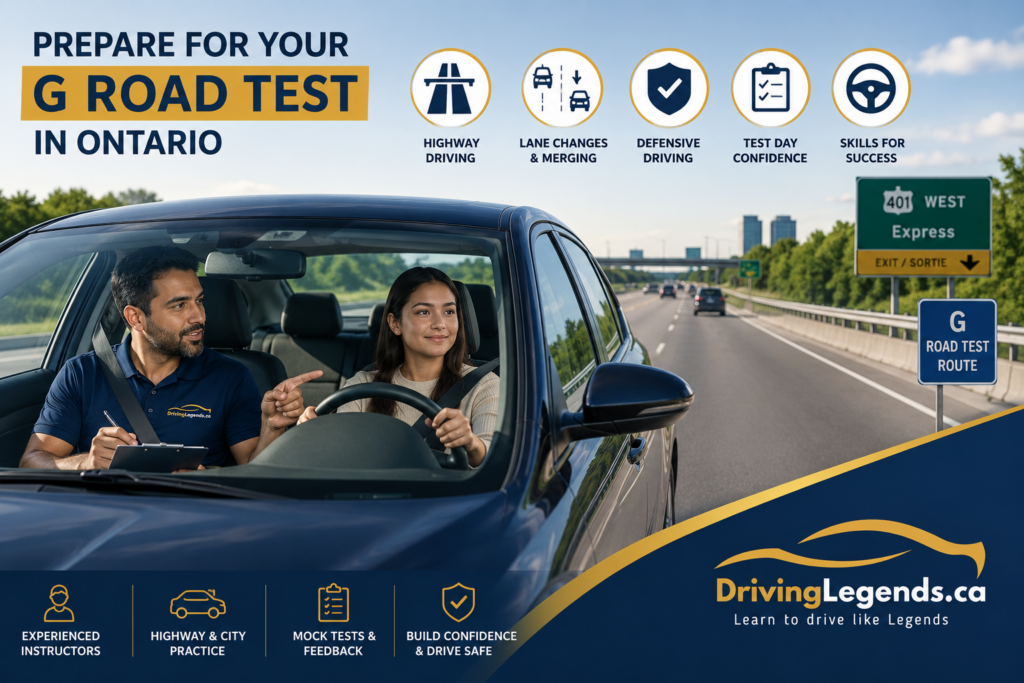
Earning your full G licence is the final step in Ontario’s graduated licensing system and a major milestone for every driver. Unlike the G2 test, the G Road Test focuses heavily on advanced driving skills, including highway driving, lane changes, merging, and defensive driving techniques. Many drivers feel nervous before their test because highway driving can seem intimidating. However, with proper preparation, consistent practice, and professional G Driving Lessons, you can build the confidence and skills needed to pass successfully. In this guide, we’ll cover everything you need to know about G Road Test preparation, common mistakes to avoid, and how G License Driving Lessons can help you become a safe and confident driver. Understanding the Ontario G Road Test The Ontario G Road Test evaluates your ability to drive independently and safely in a variety of traffic conditions. Unlike the G2 road test, which focuses on basic driving skills, the G test assesses: Highway driving Merging and exiting highways Lane changes at higher speeds Defensive driving skills Traffic awareness Speed management Decision-making under real traffic conditions The examiner wants to see that you can safely handle complex driving situations without assistance. Why G Driving Lessons Are Important Many drivers assume that because they already hold a G2 licence, they don’t need professional training. However, advanced driving skills require proper guidance and practice. Professional G Driving Lessons help drivers: Improve highway driving confidence Learn proper merging techniques Master lane changes at highway speeds Develop defensive driving habits Correct bad driving habits Understand examiner expectations Increase their chances of passing on the first attempt Even experienced drivers often discover habits they didn’t realize could affect their road test performance. What Is Included in G License Driving Lessons? Professional G License Driving Lessons focus specifically on the skills required for the final road test. These lessons typically include: Highway Driving Practice Many drivers feel uncomfortable driving at highway speeds. Your instructor will teach: Entering highways safely Maintaining proper speed Merging with traffic Following distance management Exiting highways safely Learning these skills in a controlled environment helps reduce anxiety during the actual test. Advanced Lane Changes Highway lane changes require greater awareness than city driving. You’ll practice: Mirror checks Blind spot checks Proper signaling Safe gap selection Smooth lane transitions Examiners pay close attention to lane-changing techniques during the G test. Defensive Driving Techniques Defensive driving is one of the most valuable skills you’ll learn. This includes: Identifying potential hazards Anticipating other drivers’ actions Managing space around your vehicle Avoiding aggressive driving situations Maintaining safe following distances These habits not only help you pass your test but also keep you safer on the road for years to come. Key Skills Tested During the G Road Test Understanding what examiners look for can help you prepare effectively. Highway Merging Examiners assess whether you: Accelerate appropriately Match traffic speed Use mirrors correctly Check blind spots Merge smoothly and safely Hesitation during merging is a common reason for losing marks. Highway Exits You’ll be evaluated on: Early lane positioning Proper signaling Speed adjustment Safe exiting techniques Examiners want to see smooth, controlled movements rather than last-minute decisions. Lane Changes Proper lane changes require: Mirror checks Shoulder checks Signaling Safe execution Missing blind spot checks is one of the most common road test errors. Traffic Awareness Examiners continuously observe your ability to: Scan intersections Monitor surrounding traffic Watch for pedestrians Recognize hazards Respond appropriately to changing conditions Situational awareness is a critical component of safe driving. Speed Management Driving too slowly can be just as problematic as speeding. You should: Follow posted speed limits Match traffic flow when appropriate Adjust speed for road conditions Maintain consistent control Professional G Driving Lessons help drivers become comfortable maintaining highway speeds. Common Reasons Drivers Fail the G Road Test Many road test failures occur due to preventable mistakes. Common issues include: Incomplete Blind Spot Checks Examiners need to see clear shoulder checks during lane changes and merges. Poor Highway Merging Failing to reach highway speed before merging can create dangerous situations. Inconsistent Speed Driving significantly below the speed limit may indicate lack of confidence. Lack of Observation Missing pedestrians, signs, or surrounding traffic can result in deductions. Following Too Closely Tailgating demonstrates poor defensive driving skills. Hesitation Unnecessary hesitation at intersections or during lane changes may suggest uncertainty. How to Prepare for Your G Road Test Practice Highway Driving Regularly Highway driving is one of the biggest differences between the G2 and G tests. Try practicing: Highway entry ramps Merging with traffic Highway exits Multi-lane driving Lane changes The more exposure you have, the more comfortable you’ll become. Take Professional G License Driving Lessons Working with an experienced instructor can help identify weaknesses before test day. Professional instructors understand: Current road test requirements Examiner expectations Common mistakes Effective driving techniques Targeted coaching can significantly improve your performance. Familiarize Yourself With the Test Area If possible, practice driving near your test centre. This helps you become familiar with: Highway routes Speed limits Traffic patterns Common test roads Familiarity can reduce stress on test day. Review Defensive Driving Principles Good drivers constantly scan the road and anticipate potential hazards. Remember to: Check mirrors frequently Maintain safe following distances Keep your eyes moving Stay aware of surrounding traffic Defensive driving habits are highly valued by examiners. Get Comfortable Driving at Highway Speeds Some drivers pass their G2 test without much highway experience. The G test requires confidence at speeds of 80–100 km/h or higher, depending on the route. Professional G Driving Lessons provide structured practice that helps drivers feel comfortable in these conditions. Test Day Tips The day of your road test can feel stressful, but preparation helps. Arrive Early Give yourself enough time to check in and relax. Check Your Vehicle Ensure: Lights are working Signals function properly Tires are in good condition Windshield is clean Stay Calm Examiners understand that candidates may be nervous. Focus on safe driving rather than trying to be perfect. Listen Carefully Pay close attention to
G2 Driving Lessons: A Complete Beginner’s Guide
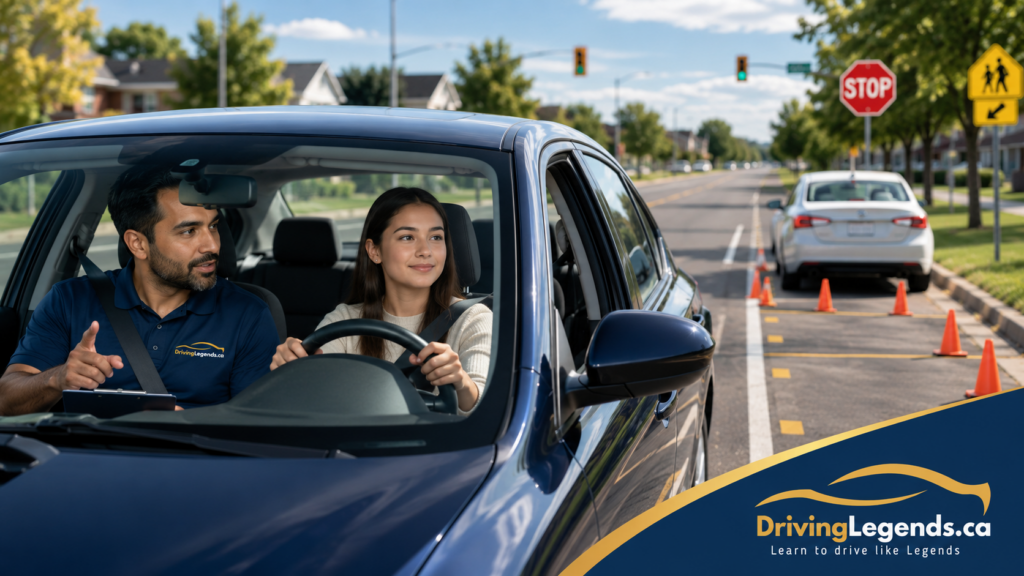
Getting your G2 licence is an exciting milestone on your journey to becoming a confident and independent driver. While earning your G1 licence allows you to begin learning, G2 Driving Lessons help you develop the practical skills needed to drive safely in real-world traffic and successfully pass the G2 road test. Whether you’re driving for the first time or looking to improve your confidence behind the wheel, structured lessons with a professional instructor can make a significant difference. In this guide, we’ll explain everything beginners need to know about G2 driving lessons, including what you’ll learn, why they matter, and how to prepare for success. What Are G2 Driving Lessons? G2 Driving Lessons are practical, behind-the-wheel training sessions designed to prepare G1 drivers for the Ontario G2 road test. These lessons focus on developing safe driving habits, improving vehicle control, and teaching drivers how to handle various traffic situations confidently. Unlike classroom learning, G2 lessons provide real driving experience under the guidance of a certified driving instructor. The primary goal is not just to pass the road test but to become a responsible and defensive driver for everyday driving. Who Should Take G2 Driving Lessons? G2 Driving Lessons are ideal for: New drivers preparing for the G2 road test G1 licence holders with little driving experience Nervous or anxious drivers International drivers adapting to Ontario road rules Drivers who want professional guidance before their road test Even if you’ve practiced with family or friends, professional instruction helps eliminate bad habits and ensures you’re learning the correct driving techniques. Why Professional G2 Driving Lessons Matter Many people believe they can learn everything from family members. While practice is important, professional lessons provide several advantages. Learn Correct Driving Techniques Certified instructors teach proper driving methods that align with Ontario road test requirements. Build Safe Driving Habits You’ll learn defensive driving techniques that help reduce risks and improve decision-making on the road. Receive Immediate Feedback Professional instructors identify mistakes early and provide practical solutions before they become habits. Increase Road Test Confidence Knowing exactly what examiners expect helps reduce anxiety and improves your chances of passing. Practice in Real Traffic Conditions Lessons include residential streets, busy intersections, multi-lane roads, and parking situations that prepare you for everyday driving. What You’ll Learn in G2 Driving Lessons A well-structured lesson covers every essential driving skill needed for safe driving and the G2 road test. Vehicle Familiarization Before driving, you’ll learn: Dashboard controls Steering techniques Mirror adjustments Seat positioning Vehicle safety checks Understanding your vehicle builds confidence from the beginning. Starting and Stopping Smoothly One of the first skills beginners learn is controlling the vehicle smoothly. You’ll practice: Smooth acceleration Gentle braking Safe stopping distances Proper use of pedals Good vehicle control creates a comfortable and safe driving experience. Steering Control Proper steering improves vehicle stability and road positioning. You’ll learn: Hand positioning Smooth steering techniques Turning accurately Maintaining lane position Left and Right Turns Turning correctly is one of the most common skills evaluated during the road test. Lessons include: Signal timing Speed control Proper lane positioning Looking for pedestrians Completing turns safely Lane Changes Changing lanes safely requires observation and good judgment. Your instructor will teach: Mirror checks Blind spot checks Proper signaling Safe merging Maintaining speed Parking Techniques Parking is an important part of every driver’s skill set. You’ll practice: Parallel parking Reverse parking Angle parking Uphill parking Downhill parking These techniques become easier with repeated practice. Three-Point Turns You’ll learn when and how to perform a safe three-point turn while maintaining awareness of surrounding traffic. Emergency Stops Professional lessons teach you how to respond calmly during unexpected situations. You’ll practice: Controlled emergency braking Safe stopping procedures Hazard awareness Speed Management Maintaining an appropriate speed is essential for road safety. Lessons cover: School zones Residential streets Urban roads Speed limit awareness Smooth acceleration Traffic Signs and Road Rules Although you’ve already passed the G1 knowledge test, instructors reinforce important road rules during practical driving. You’ll learn to respond correctly to: Stop signs Yield signs Traffic lights School crossings Railway crossings Defensive Driving One of the most valuable skills taught during G2 Driving Lessons is defensive driving. This includes: Anticipating hazards Keeping safe following distances Scanning intersections Avoiding distractions Managing blind spots Defensive driving helps reduce the risk of collisions and makes you a more confident driver. Common Mistakes Beginners Make Many new drivers struggle with similar challenges. Some common mistakes include: Forgetting blind spot checks Driving too slowly or too fast Rolling through stop signs Poor steering control Incorrect lane positioning Late signaling Incomplete shoulder checks Hesitating unnecessarily at intersections Professional instruction helps correct these mistakes before your road test. How Many G2 Driving Lessons Do You Need? There is no fixed number of lessons because every learner progresses differently. The number of lessons depends on: Previous driving experience Confidence level Practice outside lessons Ability to learn new skills Road test readiness Some learners need only a few lessons for polishing skills, while complete beginners often benefit from a structured lesson package. The focus should always be on becoming a safe driver rather than simply completing a certain number of lessons. How to Prepare for Your G2 Driving Lessons You can make every lesson more productive by preparing in advance. Get Enough Rest Being alert helps you learn faster and make better driving decisions. Wear Comfortable Shoes Comfortable footwear provides better pedal control. Bring Your G1 Licence Always carry your valid licence for every lesson. Stay Relaxed Making mistakes is a normal part of learning. Practice Between Lessons The more you practice, the faster your confidence and skills improve. Tips for Passing Your G2 Road Test Here are a few practical tips that can improve your chances of success: Perform mirror and blind spot checks consistently. Follow posted speed limits. Come to complete stops at stop signs. Signal before every turn and lane change. Keep both hands on the steering wheel whenever possible. Stay calm and avoid rushing decisions. Watch carefully for
How to Choose the Right Driving School in Hamilton, Ontario

Learning to drive is an important milestone, and choosing the right driving school can make a significant difference in your experience and long-term driving skills. Whether you’re a first-time driver, a newcomer to Canada, or someone preparing for a licence upgrade, selecting a reputable driving school is the first step toward becoming a safe and confident driver. With so many options available, finding the best Driving School in Hamilton can feel overwhelming. Every school offers different lesson plans, instructors, pricing, and teaching methods. Taking the time to compare your options will help you make an informed decision. At Driving Legends, we believe every student deserves professional instruction, personalized training, and the confidence to drive safely on Ontario roads. In this guide, we’ll explain the key factors to consider when choosing the right driving school in Hamilton. 1. Look for Certified and Experienced Instructors The quality of your instructor has a direct impact on your learning experience. A knowledgeable instructor not only teaches you how to operate a vehicle but also helps you develop safe driving habits that last a lifetime. When choosing a driving school, ask whether the instructors are: Professionally trained and licensed Patient and supportive Experienced in teaching beginner drivers Familiar with Ontario traffic laws and road test requirements A good instructor understands that every student learns differently and adapts lessons to match your pace and confidence level. 2. Choose a Ministry-Approved BDE Course If you’re a new driver, enrolling in a Beginner Driver Education (BDE) course is a smart investment. A Ministry-approved BDE course offers several benefits, including: Structured classroom or online learning Professional in-car driving lessons Safe driving techniques Defensive driving strategies Eligibility to reduce your G1 waiting period from 12 months to 8 months (subject to Ontario licensing rules) Professional driver education helps you build a strong foundation before driving independently. 3. Check the Driving Lesson Packages Every learner has different goals, so choose a driving school that offers flexible lesson packages. Look for services such as: Beginner driving lessons Refresher driving lessons G2 driving lessons G licence preparation Individual driving lessons Road test preparation Mock driving assessments Flexible packages allow you to choose lessons that fit your schedule, experience level, and budget. 4. Read Student Reviews and Testimonials Online reviews provide valuable insight into the experiences of previous students. When researching a Driving School in Hamilton, look for comments about: Instructor professionalism Teaching quality Punctuality Communication Student confidence Overall satisfaction Consistently positive reviews are often a good indicator of reliable service. 5. Ask About Lesson Scheduling Convenient scheduling makes it easier to complete your driving lessons consistently. Choose a school that offers: Weekday lessons Evening lessons Weekend lessons Flexible booking options Easy rescheduling when needed Consistent practice helps students learn more effectively and retain driving skills. 6. Consider the Training Vehicle Learning in a clean, modern, and well-maintained vehicle makes the experience more comfortable and safer. Ask whether the training vehicles include: Dual brake systems for instructor safety Automatic transmission options Regular maintenance and inspections Comfortable interiors for beginners Driving a reliable vehicle allows you to focus on learning rather than worrying about the car. 7. Learn Defensive Driving Skills Passing your driving test is important, but becoming a safe driver is even more valuable. Choose a school that teaches: Defensive driving techniques Hazard awareness Safe following distances Proper mirror and blind spot checks Driving in different weather conditions Sharing the road with cyclists and pedestrians These skills help reduce risks and prepare you for real-world driving situations. 8. Compare Pricing Without Sacrificing Quality Affordable pricing is important, but the cheapest option isn’t always the best value. Instead of focusing only on cost, compare: Number of in-car lessons Lesson duration Instructor qualifications Student support Included services Overall reputation Investing in quality instruction can save you time, money, and the cost of retaking a driving test. 9. Find a School That Builds Confidence Many new drivers feel nervous before getting behind the wheel. A good driving school creates a supportive learning environment where students can: Ask questions without hesitation Learn at their own pace Gain confidence gradually Improve through constructive feedback Confidence is one of the biggest factors in becoming a safe driver. 10. Choose a Local Driving School A local driving school understands the roads, traffic conditions, and driving challenges in your area. Learning with instructors who know Hamilton allows you to become familiar with: Residential streets Busy intersections School zones Roundabouts Common road test routes Local traffic patterns This local knowledge helps students feel more comfortable when driving independently. Why Choose Driving Legends? At Driving Legends, we’re committed to helping students become safe, confident, and responsible drivers. Our personalized approach ensures every lesson is tailored to your experience level and learning goals. We offer: Certified and experienced driving instructors Ministry-approved Beginner Driver Education (BDE) courses One-on-one in-car driving lessons G2 driving lessons G licence preparation Mock driving assessments Flexible scheduling Affordable lesson packages Friendly, patient instruction We proudly serve students in Hamilton, Burlington, Oakville, Milton, Mississauga, Stoney Creek, Ancaster, and surrounding Ontario communities. Whether you’re learning to drive for the first time or preparing for your next licence level, our team is here to support you every step of the way. Final Thoughts Choosing the right Driving School in Hamilton is one of the most important decisions you’ll make as a new driver. A professional driving school provides more than just lessons—it helps you develop lifelong driving skills, confidence, and safe habits that will benefit you for years to come. Before enrolling, compare instructors, lesson packages, reviews, scheduling options, and the quality of training provided. Taking the time to choose a reputable driving school will make your learning experience more enjoyable and increase your confidence on the road. If you’re looking for professional driving lessons in Hamilton, Driving Legends is ready to help. Our experienced instructors, flexible lesson options, and commitment to student success make us a trusted choice for learners across the region. Contact Driving Legends today to book your driving
How Many Driving Lessons Do You Need Before the G2 Test?

If you’re preparing to earn your G2 licence in Ontario, one of the most common questions is, “How many G2 driving lessons do I need before my driving test?” The answer depends on your previous driving experience, confidence behind the wheel, and how quickly you develop safe driving habits. Some learners are ready after a few professional lessons, while others benefit from additional practice before booking their driving test. The goal isn’t simply to complete a certain number of lessons—it’s to become a safe, confident, and responsible driver. At Driving Legends, we provide personalized G2 driving lessons that help students build the skills and confidence needed to succeed on their Ontario driving test. Is There a Required Number of G2 Driving Lessons? There is no legal requirement to complete a specific number of G2 driving lessons before taking your Ontario driving test. However, completing professional driving lessons is one of the best ways to improve your driving skills and prepare for the test. To be eligible for your G2 licence, you must: Hold your G1 licence for at least 12 months, or 8 months after successfully completing an approved Beginner Driver Education (BDE) course. Gain supervised driving experience while following all G1 licence restrictions. Professional instruction helps you learn proper driving techniques, avoid common mistakes, and become a safer driver. How Many G2 Driving Lessons Do Most Students Need? The number of lessons varies from student to student. Complete Beginners If you’ve never driven before, most students benefit from 10–15 G2 driving lessons, along with regular practice outside of class. These lessons typically cover: Vehicle controls Steering techniques Safe braking and acceleration Lane positioning Mirror and blind spot checks Left and right turns Parking techniques Residential and city driving Regular practice between lessons helps reinforce these skills and improves confidence. Drivers with Some Experience If you’ve already practiced with a family member or friend, you may only need 5–8 G2 driving lessons to refine your skills and prepare for your driving test. A certified instructor can identify unsafe habits, improve your technique, and ensure you’re driving according to Ontario standards. Experienced Drivers If you’re already comfortable behind the wheel, 2–4 refresher G2 driving lessons may be enough. These sessions often include: Mock driving tests Parking practice Lane change techniques Test route practice Personalized feedback Why Professional G2 Driving Lessons Matter Learning from family members provides valuable experience, but professional G2 driving lessons offer structured training based on Ontario’s licensing standards. At Driving Legends, our certified instructors help students: Build safe driving habits Increase confidence in different traffic conditions Correct common driving mistakes Learn defensive driving techniques Prepare for real driving situations Our goal is to help every student become a safe and confident driver—not just pass the driving test. Skills You Should Master Before Booking Your Test Before scheduling your Ontario driving test, you should feel comfortable with: Smooth starts and stops Proper steering control Lane changes with mirror and blind spot checks Left and right turns Four-way stop procedures Traffic light intersections Parallel parking Reverse parking Uphill and downhill parking Three-point turns Speed management Maintaining a safe following distance Sharing the road with cyclists and pedestrians Defensive driving techniques If any of these skills need improvement, additional G2 driving lessons can help you gain confidence. Practice Between Lessons Professional lessons are only part of your learning journey. Practicing regularly with a qualified supervising driver helps reinforce what you’ve learned. Practice driving in: Residential neighbourhoods Busy city streets Parking lots Multi-lane roads Different weather conditions (when safe) The more driving experience you gain, the more confident you’ll become. Signs You’re Ready You may be ready to book your driving test if you can: Drive confidently without constant instruction. Follow traffic signs and road rules naturally. Perform consistent mirror and blind spot checks. Complete parking manoeuvres accurately. Change lanes safely. Stay calm in moderate traffic. Make safe driving decisions independently. A mock driving assessment with a professional instructor is an excellent way to measure your readiness. Common Mistakes Students Make Many students attempt their driving test before they’re fully prepared. Some common mistakes include: Forgetting blind spot checks Rolling through stop signs Speeding or driving too slowly Poor lane positioning Missing mirror checks Failing to signal properly Lack of confidence Professional G2 driving lessons help eliminate these mistakes before test day. Learn with Driving Legends At Driving Legends, we understand that every learner progresses at a different pace. That’s why we tailor our G2 driving lessons to your individual needs and experience level. We offer: Certified and experienced instructors One-on-one in-car lessons Beginner Driver Education (BDE) courses G2 and G licence preparation Mock driving assessments Flexible lesson scheduling Friendly and patient instruction We proudly serve students in Hamilton, Burlington, Milton, Oakville, Mississauga, Ancaster, Stoney Creek, and nearby Ontario communities. Final Thoughts There is no perfect number of G2 driving lessons that fits every learner. Some students become test-ready after a few lessons, while others benefit from additional instruction and practice. The key is to build the knowledge, confidence, and safe driving habits needed to drive independently and responsibly. If you’re looking for professional G2 driving lessons in Hamilton, Driving Legends is here to help. Our experienced instructors provide personalized training to help you improve your skills, boost your confidence, and prepare for success on your Ontario driving test. Book your G2 driving lessons with Driving Legends today and take the next step toward becoming a safe and confident driver.
Common Reasons Students Fail the G2 Road Test (And How to Avoid Them)

Passing your G2 Road Test is an exciting milestone on your journey to becoming a confident and independent driver. While many students successfully pass on their first attempt, others fall short because of a few avoidable mistakes. The good news is that with the right preparation, professional guidance, and enough practice, you can significantly improve your chances of success. At Driving Legends, we have helped hundreds of new drivers build the skills and confidence they need to pass their G2 road test in Ontario. In this guide, we’ll cover the most common reasons students fail their G2 road test and share practical tips to help you avoid them. 1. Not Checking Blind Spots One of the most common reasons students lose marks—or even fail—is forgetting to check their blind spots. Before changing lanes, turning, merging, or pulling away from the curb, you must perform a proper shoulder check. Examiners want to clearly see you checking your blind spots, not just relying on mirrors. How to avoid it: Make shoulder checks a habit during every practice session. Turn your head enough so the examiner can clearly see the movement. Always check mirrors before checking your blind spot. 2. Poor Observation at Intersections Intersections require your full attention. Many students focus only on traffic lights and forget to scan for pedestrians, cyclists, or vehicles approaching from other directions. Examiners are looking for drivers who stay aware of everything happening around them. How to avoid it: Look left, right, and left again before proceeding. Scan for pedestrians, cyclists, and turning vehicles. Never rush through an intersection. 3. Rolling Stops A rolling stop occurs when a driver slows down but doesn’t come to a complete stop at a stop sign. This is one of the easiest mistakes to avoid but remains one of the most common reasons for failing the G2 road test. How to avoid it: Bring your vehicle to a complete stop. Count to two seconds if necessary. Proceed only when it is safe. 4. Speeding or Driving Too Slowly Maintaining the correct speed is essential. Driving above the speed limit is dangerous, but driving well below it can also create unsafe situations and show a lack of confidence. How to avoid it: Keep an eye on speed limit signs. Match traffic flow while staying within legal limits. Practice maintaining a consistent speed. 5. Improper Lane Changes Many students fail because they don’t follow the proper lane-changing procedure. The correct sequence is: Check your rear-view mirror. Check your side mirror. Signal. Check your blind spot. Change lanes smoothly. Skipping any of these steps may result in lost marks. 6. Difficulty with Parallel Parking Parallel parking often makes new drivers nervous. Fortunately, the examiner isn’t expecting perfection—they want to see safe vehicle control and proper observation. How to avoid it: Practice regularly in different locations. Use mirrors effectively. Move slowly and make adjustments if needed. Always check your surroundings before reversing. 7. Poor Steering Control Holding the steering wheel incorrectly or making sudden steering movements can make the examiner question your control of the vehicle. Good steering demonstrates confidence and smooth driving. How to avoid it: Keep both hands on the steering wheel whenever possible. Turn smoothly. Avoid overcorrecting. 8. Failing to Yield Many students lose marks because they don’t properly yield to: Pedestrians Cyclists Oncoming traffic Vehicles with the right of way Failure to yield is considered a serious safety issue. How to avoid it: Slow down when approaching intersections. Be patient. Never assume another driver will stop. 9. Poor Parking Skills Besides parallel parking, students may also be asked to perform: Uphill parking Downhill parking Reverse parking Front parking Incorrect wheel positioning or forgetting to use the parking brake can cost valuable marks. How to avoid it:Practice each parking method until it becomes second nature. 10. Lack of Confidence Many students know how to drive but become nervous during the road test. Anxiety can lead to forgotten shoulder checks, missed signs, hesitation, and unnecessary mistakes. How to avoid it: Take several mock road tests. Practice in different traffic conditions. Get enough rest before your test. Arrive early and stay calm. 11. Inadequate Mirror Checks Your examiner wants to see that you’re constantly aware of your surroundings. Checking mirrors only occasionally isn’t enough. How to avoid it:Develop the habit of checking mirrors every few seconds and before every speed or direction change. 12. Not Practicing Enough Some students attempt the G2 road test after only a few hours of driving practice. Driving requires muscle memory, judgment, and confidence that can only be built through consistent practice. Professional instruction helps you learn correct driving habits from the beginning and prepares you for real test situations. Tips to Increase Your Chances of Passing Here are a few simple ways to improve your chances of success: Practice regularly with a licensed instructor. Learn the routes commonly used for G2 road tests. Stay calm and focused throughout the exam. Follow speed limits and road signs. Always perform shoulder checks. Keep a safe following distance. Practice parking until you’re comfortable. Book a mock road test before your actual exam. Why Choose Driving Legends? Choosing the right driving school can make all the difference in your road test performance. At Driving Legends, our certified instructors focus on building safe driving habits, confidence, and real-world skills. Whether you’re a beginner or preparing specifically for your G2 Road Test, our personalized lessons are designed to help you succeed. Our students benefit from: Certified and experienced instructors One-on-one driving lessons Flexible scheduling G2 and G road test preparation Mock road tests Beginner-friendly instruction Affordable lesson packages We proudly help students across Hamilton and surrounding Ontario communities become safe, responsible, and confident drivers. Final Thoughts Failing a G2 road test can be discouraging, but most failures happen because of small, preventable mistakes. By understanding what examiners are looking for and practicing the right techniques, you can greatly improve your chances of passing on your first attempt. If you’re preparing for your
How to Pass Your G2 Road Test on the First Attempt

Passing your G2 road test is a major milestone for every new driver in Ontario. It brings you one step closer to full driving freedom and greater confidence on the road. However, many learners feel nervous before the test because they are unsure what to expect or worried about making mistakes under pressure. The good news is that passing your G2 road test on the first attempt is completely achievable with the right preparation, practice, and mindset. Understanding the test structure, improving your driving habits, and avoiding common errors can significantly increase your chances of success. In this guide, we’ll cover everything you need to know to confidently pass your G2 road test on your first try. Understand What the G2 Road Test Includes Before you begin preparing, it’s important to understand what the examiner will evaluate during the test. The Ontario G2 road test focuses on basic driving skills and your ability to drive safely in real traffic situations. During the test, the examiner may assess: Proper vehicle control Lane changes Left and right turns Intersection handling Stop signs and traffic lights Parallel parking Three-point turns Parking on hills Speed control Observation skills Mirror and blind spot checks The examiner is not expecting perfection. They want to see that you can drive safely, confidently, and responsibly. Practice Consistently Before the Test One of the biggest reasons people fail their G2 test is lack of practice. Driving occasionally is not enough. Consistent practice helps build muscle memory and improves your reaction time in different traffic situations. Try to practice in: Residential streets Busy intersections Main roads School zones Parking lots High-traffic areas Practice during different times of the day, including rush hour and evening driving, so you become comfortable in various conditions. The more real-world experience you gain, the more relaxed and prepared you will feel during the actual test. Learn the Most Common G2 Test Mistakes Knowing what causes most drivers to fail can help you avoid unnecessary errors. 1. Forgetting Blind Spot Checks This is one of the most common reasons for failure. Many drivers check mirrors but forget to physically turn their head to check blind spots before: Lane changes Turns Pulling over Leaving a parking position Make your blind spot checks obvious so the examiner can clearly see them. 2. Rolling Stops At stop signs, your vehicle must come to a complete stop behind the line. Rolling through a stop sign can result in automatic deductions and may even lead to failure. Always: Stop fully Look left, right, and left again Proceed only when safe 3. Driving Too Slowly or Too Fast Many nervous drivers drive below the speed limit because they think it is safer. However, driving too slowly can disrupt traffic and show lack of confidence. Drive according to: Posted speed limits Road conditions Traffic flow Maintain steady and controlled speed throughout the test. 4. Poor Observation at Intersections Examiners pay close attention to your scanning habits. Always check: Left Right Left again Do this at every intersection, even when the light is green. 5. Improper Lane Changes Before changing lanes: Check rear-view mirror Check side mirror Check blind spot Signal Change lanes smoothly Avoid sudden or aggressive lane movements. Take a Professional Driving Lesson Even if you already know how to drive, taking lessons from a certified driving instructor can make a huge difference. Professional instructors can: Identify bad habits Teach test-specific techniques Simulate real test routes Improve parking skills Boost your confidence Many driving schools in Ontario also offer mock road tests that closely resemble the actual exam experience. A few professional lessons before your test can help you feel much more prepared. Practice Parallel Parking Until It Feels Natural Parallel parking is often one of the most stressful parts of the G2 test. The key is repetition and proper technique. When practicing: Use cones or parked cars Focus on steering control Practice both left and right-side parking Learn reference points Remember:The examiner is looking for safe and controlled parking, not perfect parking. Even if you need a small adjustment, stay calm and complete the maneuver safely. Get Familiar with the Test Area If possible, practice around the test center where your exam will take place. This helps you: Understand local speed limits Identify tricky intersections Recognize school zones Become comfortable with nearby roads Many test centers use similar routes regularly, so local practice can give you an advantage. Prepare Your Vehicle Before the Test Your car must be in proper working condition on test day. Examiners may cancel the test if the vehicle is unsafe. Before your appointment, check: Brake lights Turn signals Headlights Horn Windshield wipers Tires Mirrors Fuel level Also ensure the car interior is clean and distraction-free. Stay Calm and Confident During the Test Nervousness is normal, but confidence plays a big role in your performance. Here are a few ways to stay calm: Get enough sleep the night before Arrive early Take deep breaths Listen carefully to instructions Focus on one task at a time Remember that small mistakes usually won’t fail you. Examiners understand that learners may feel nervous. What matters most is safe decision-making. Use Proper Steering Techniques Good steering control demonstrates confidence and vehicle awareness. Avoid: One-handed steering Oversteering Crossing hands aggressively Use smooth and controlled movements while maintaining proper lane positioning. Always Signal Early Signal communication is essential for safe driving. Use signals: Before turns Before lane changes When pulling over When leaving a parking spot Signal early enough to give other drivers time to react. Check Mirrors Frequently Examiners want to see active observation skills throughout the drive. Check mirrors regularly: Every few seconds Before slowing down Before stopping Before turning Before lane changes Avoid staring too long. Quick and frequent mirror checks are ideal. Be Careful in School Zones and Residential Areas Many drivers lose marks because they forget to reduce speed in school zones or residential streets. Watch carefully for: Pedestrians Cyclists Parked cars Children crossing Reduced speed signs