
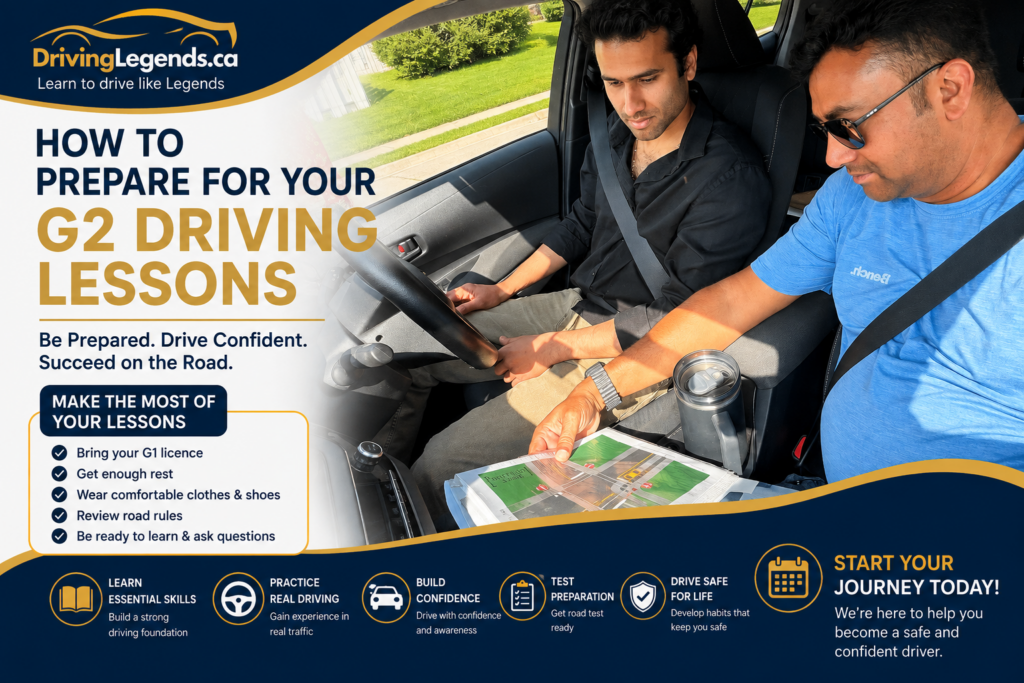
Starting your G2 driving lessons is an exciting step toward becoming an independent driver in Ontario. After earning your G1 licence, you’re ready to gain practical experience and learn how to handle real-world driving situations.
However, getting the most out of your lessons requires more than simply sitting behind the wheel. Proper preparation can help you feel more comfortable, learn faster, and build good driving habits from the beginning.
Whether you’re a complete beginner or you’ve already had some practice with a family member or friend, knowing what to expect can make your G2 Driving Lessons more productive.
In this guide, we’ll explain how to prepare for your lessons, what to bring, what skills you should focus on, and how to make steady progress toward your G2 road test.
What Are G2 Driving Lessons?
G2 driving lessons are practical training sessions designed to help G1 drivers develop the skills needed to drive safely and confidently.
During professional lessons, an instructor can teach and evaluate important skills such as:
- Vehicle control
- Steering
- Starting and stopping
- Turns
- Lane changes
- Mirror and shoulder checks
- Parking
- Three-point turns
- Intersections
- Speed management
- Defensive driving
- Road test preparation
Lessons are usually adjusted according to your experience and individual learning needs.
A beginner may spend more time learning basic vehicle control, while a more experienced learner may focus on correcting specific habits and preparing for the G2 road test.
1. Bring Your G1 Licence
Before your lesson, make sure you have your valid G1 licence with you.
Your instructor may need to confirm that you’re legally permitted to participate in the lesson. Keeping your licence with you also prevents unnecessary delays.
It’s a simple step, but checking your documents before leaving home can make your lesson start smoothly.
2. Get Enough Rest Before Your Lesson
Driving requires concentration, observation, and quick decision-making.
Avoid arriving for a lesson when you’re extremely tired or distracted. Getting enough sleep beforehand can help you:
- Concentrate better
- React more quickly
- Remember instructions
- Stay calm in traffic
- Make better decisions
Your physical and mental condition can affect how effectively you learn.
3. Wear Comfortable Clothing and Shoes
Choose clothing that allows you to move comfortably and footwear that provides good pedal control.
Avoid shoes that make it difficult to feel the accelerator or brake.
Comfortable clothing and appropriate footwear can help you focus on driving instead of adjusting your clothes or worrying about your feet.
4. Review Basic Ontario Road Rules
You don’t need to memorize everything before your first lesson, but reviewing basic road rules can give you a strong starting point.
Before your lessons, review:
- Stop signs
- Yield signs
- Traffic lights
- Speed limits
- Right-of-way rules
- School zones
- Pedestrian crossings
- Lane markings
- Parking restrictions
Understanding the rules makes it easier to focus on practical driving skills when you’re behind the wheel.
5. Know What You Want to Improve
Before your lesson starts, think about areas where you feel less confident.
For example, you might be uncomfortable with:
- Parallel parking
- Changing lanes
- Busy intersections
- Highway driving
- Left turns
- Reverse parking
- Driving in heavy traffic
Tell your instructor about these concerns.
Professional instruction becomes more useful when your instructor understands where you need additional practice.
6. Don’t Worry About Making Mistakes
One of the biggest mistakes new drivers make is worrying too much about making mistakes.
Remember that driving lessons are for learning.
You may:
- Forget a shoulder check
- Turn too wide
- Brake too quickly
- Misjudge a parking maneuver
- Become nervous at an intersection
That’s completely normal.
Instead of becoming frustrated, listen to your instructor’s feedback and try the skill again. Repetition is one of the best ways to develop good driving habits.
7. Learn Proper Mirror and Shoulder Checks
Observation is one of the most important parts of safe driving.
Before and during your G2 driving lessons, start developing the habit of regularly checking:
- Rear-view mirror
- Side mirrors
- Blind spots
Shoulder checks are particularly important when changing lanes or making certain movements around other vehicles.
Don’t treat observation as something you only do during the road test. Make it part of your everyday driving routine.
8. Practice Basic Vehicle Control
Before moving into complicated traffic situations, make sure you’re becoming comfortable controlling the vehicle.
Important skills include:
Smooth Acceleration
Avoid pressing the accelerator too aggressively.
Controlled Braking
Practice stopping smoothly while maintaining a safe distance.
Steering
Keep the vehicle properly positioned within your lane.
Speed Control
Learn to maintain an appropriate speed without constantly accelerating and braking.
Strong vehicle control provides the foundation for more advanced driving skills.
9. Prepare to Learn Parking Skills
Parking can be challenging for new drivers, so don’t be discouraged if it takes several attempts to feel comfortable.
Your lessons may include:
- Parallel parking
- Reverse parking
- Angle parking
- Hill parking
- Pulling into and out of parking spaces
Instead of trying to memorize every movement, focus on understanding the positioning of the vehicle and developing good observation habits.
With repeated practice, parking becomes much more natural.
10. Practice Turns and Intersections
Intersections require drivers to make several decisions at once.
During your lessons, you’ll learn how to:
- Approach intersections safely
- Position your vehicle correctly
- Signal appropriately
- Check for pedestrians
- Observe traffic signs and signals
- Yield when required
- Complete left and right turns safely
Your instructor can gradually introduce more complicated intersections as your confidence improves.
11. Be Ready to Learn Lane Changes
Lane changes are an important part of everyday driving and G2 road test preparation.
A safe lane change generally involves:
Mirror → Signal → Shoulder Check → Safe Gap → Smooth Movement
Your instructor will help you develop this routine until it becomes a natural part of your driving.
Avoid rushing a lane change. If there isn’t a safe gap, wait for one.
12. Ask Questions During Your Lessons
Don’t be afraid to ask your instructor questions.
For example:
- Why should I position the vehicle this way?
- When should I check my blind spot?
- How can I improve my parallel parking?
- When should I start slowing down?
- What should I do if another driver doesn’t yield?
- What skills should I practice before my G2 road test?
Understanding why you’re doing something can help you remember the correct technique.
13. Practice Outside Your Professional Lessons
Professional lessons are extremely valuable, but additional legal and supervised practice can help reinforce what you’ve learned.
If you’re practicing with a qualified accompanying driver, try to repeat the same techniques your instructor taught you.
For example, if your instructor has taught you a specific observation routine for lane changes, continue using that routine during your practice sessions.
Consistency helps turn individual skills into automatic habits.
14. Keep Track of Your Progress
After each lesson, take a few minutes to think about what you learned.
You could make a simple list such as:
Skills I’m comfortable with:
- Starting and stopping
- Basic turns
- Residential driving
Skills I need to practice:
- Parallel parking
- Lane changes
- Busy intersections
This helps you and your instructor focus future lessons on the areas that need the most attention.
15. Gradually Build Your Driving Confidence
Confidence doesn’t mean driving aggressively or assuming you know everything.
Real driving confidence comes from:
- Understanding road rules
- Controlling your vehicle
- Observing your surroundings
- Making safe decisions
- Knowing how to respond to hazards
If you’re nervous, don’t rush into difficult situations. Build your skills gradually.
A good instructor will introduce more challenging situations as your abilities improve.
16. Learn Defensive Driving Habits
Your G2 lessons should prepare you for more than just the road test.
Defensive driving teaches you to anticipate what other road users might do.
For example, if a vehicle is approaching an intersection too quickly, don’t assume the driver will stop. Be prepared to respond safely.
Defensive driving includes:
- Maintaining a safe following distance
- Scanning ahead
- Watching surrounding vehicles
- Identifying hazards
- Avoiding distractions
- Adjusting your speed to conditions
These habits can help you stay safer long after you receive your G2 licence.
17. Prepare for Your G2 Road Test
As your skills improve, your lessons can become more focused on G2 road test preparation.
Your instructor may help you evaluate:
- Observation
- Turns
- Stops
- Lane changes
- Parking
- Three-point turns
- Speed management
- Road positioning
- Signaling
- Defensive driving
A mock road test can also help identify areas that need additional practice.
The goal should be to reach a point where safe driving feels natural rather than trying to memorize a list of test actions.
Common Mistakes to Avoid During G2 Lessons
New drivers often make mistakes that can be corrected with practice.
Some common examples include:
Forgetting Shoulder Checks
Always develop consistent observation habits.
Signaling Too Late
Signal early enough to clearly communicate your intentions.
Driving Too Close to Other Vehicles
Maintain an appropriate following distance.
Focusing Only on the Vehicle Ahead
Keep scanning the road and surrounding environment.
Braking Too Hard
Try to anticipate stops and brake smoothly.
Becoming Nervous After a Mistake
One mistake doesn’t mean you’ve failed. Learn from it and continue driving safely.
How Driving Legends Can Help You Prepare
At Driving Legends, our goal is to help learners develop the practical skills and confidence needed to become safe drivers.
Our driving instruction can help you work on:
- Beginner driving skills
- G2 Driving Lessons
- Parking techniques
- Lane changes
- Defensive driving
- Road awareness
- G2 road test preparation
- Confidence behind the wheel
Our instructors can adapt lessons according to your current experience and the areas where you need additional practice.
Whether you’re taking your first lesson or getting closer to your G2 road test, structured professional instruction can help you progress with greater confidence.
Final Thoughts
Preparing for your G2 driving lessons doesn’t require you to be an expert before you get behind the wheel. The purpose of professional lessons is to help you learn, practice, make mistakes, and improve in a structured environment.
Arrive rested, bring your G1 licence, wear comfortable footwear, review basic road rules, and be prepared to ask questions. Most importantly, give yourself time to develop your skills.
With regular practice and professional guidance, you can gradually improve your vehicle control, observation, parking, lane changes, defensive driving, and overall confidence.
Your goal isn’t simply to pass the G2 road test. It’s to become a safe and responsible driver who feels comfortable handling real-world driving situations.