Getting your G2 licence is an important step toward becoming an independent driver in Ontario. While passing the G1 knowledge test gives you permission to begin driving with the appropriate restrictions, the next stage is developing the practical skills needed to drive safely and confidently on your own.
This is where G2 Driving Lessons can make a significant difference.
Professional driving lessons give you the opportunity to practice essential skills with an experienced instructor who can identify mistakes, explain proper techniques, and help you become comfortable in different traffic situations.
But what exactly is included in G2 driving lessons?
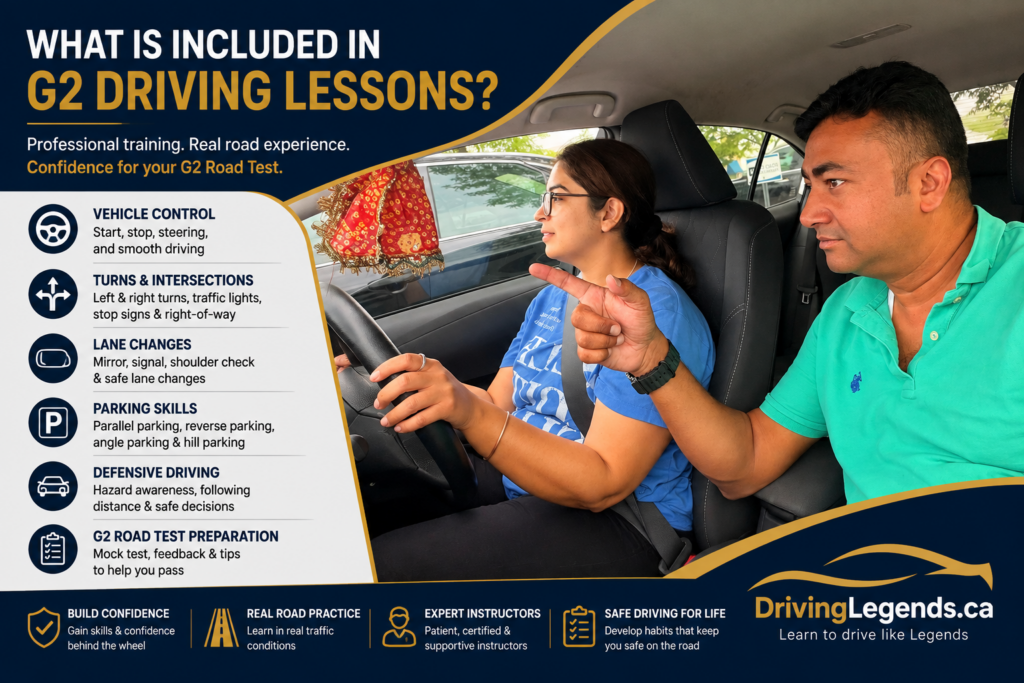
In this guide, we’ll explain the major skills and areas typically covered during professional G2 driving lessons and how this training can help you prepare for your G2 road test.
What Are G2 Driving Lessons?
G2 driving lessons are practical, behind-the-wheel training sessions designed to help beginner drivers develop the skills required for safe everyday driving and G2 road test preparation.
Lessons are generally personalized according to the student’s experience. A complete beginner may spend more time learning vehicle control and basic road skills, while an experienced G1 driver may focus more heavily on parking, lane changes, traffic situations, and test preparation.
The goal is not simply to teach you how to pass a road test. Good driving instruction helps you develop habits that remain useful long after you receive your G2 licence.
1. Vehicle Controls and Basic Car Operation
One of the first things you’ll learn is how to properly operate the vehicle.
Your instructor can help you become familiar with:
- Adjusting your seat and mirrors
- Using the steering wheel correctly
- Understanding dashboard controls
- Using turn signals
- Operating windshield wipers and lights
- Controlling the accelerator and brake
- Maintaining a comfortable driving position
Understanding the vehicle before entering busy traffic can make the learning process much less stressful.
2. Starting, Stopping and Smooth Vehicle Control
Smooth vehicle control is a foundation of good driving.
During your lessons, you’ll practice:
- Starting safely
- Accelerating smoothly
- Braking gradually
- Coming to complete stops
- Maintaining control at low speeds
- Maintaining a consistent position within your lane
New drivers sometimes press the accelerator or brake too aggressively. With practice and instructor feedback, you can learn to make these actions smoother and more predictable.
3. Steering and Lane Positioning
Correct steering technique helps you maintain control and stay properly positioned on the road.
Your instructor may work with you on:
- Steering smoothly through curves
- Maintaining your lane
- Making controlled turns
- Correcting your position when necessary
- Looking ahead rather than focusing only on the vehicle immediately in front of you
Proper lane positioning becomes especially important as you begin driving on busier roads.
4. Left and Right Turns
Turning may seem simple, but there are several things a driver needs to consider before completing a turn.
G2 driving lessons can cover:
- Proper signaling
- Checking mirrors
- Checking for pedestrians and cyclists
- Selecting the correct lane
- Controlling your speed
- Positioning the vehicle correctly
- Completing the turn safely
Repeated practice helps make these steps more natural.
5. Intersections and Right-of-Way
Intersections require constant observation and good decision-making.
You’ll learn how to approach and navigate:
- Stop signs
- Yield signs
- Traffic lights
- Uncontrolled intersections
- Left-turn situations
- Pedestrian crossings
- Busy urban intersections
Your instructor can also explain right-of-way rules and help you understand when you should proceed and when you should wait.
6. Lane Changes
Safe lane changes require more than simply turning on your signal.
A proper lane change generally involves:
- Checking your mirrors.
- Signaling your intention.
- Checking your blind spot.
- Confirming there is a safe gap.
- Moving smoothly into the new lane.
- Cancelling the signal when appropriate.
Your instructor will help you develop a consistent observation routine so that these actions become habits.
7. Blind Spot and Shoulder Checks
Blind spot awareness is one of the most important skills for new drivers.
Mirrors cannot show you everything around your vehicle. That’s why drivers need to check their blind spots before certain movements.
You may practice shoulder checks when:
- Changing lanes
- Merging
- Moving away from the curb
- Preparing for certain turns
- Entering or leaving traffic
Developing consistent observation habits is essential for both the G2 road test and everyday driving.
8. Parking Skills
Parking is a major part of learning to drive independently.
Depending on your needs, G2 Driving Lessons may include practice with:
Parallel Parking
Learning how to position and maneuver your vehicle into a space beside the curb.
Reverse Parking
Practicing how to safely reverse into a parking space while maintaining control and awareness.
Angle Parking
Learning how to enter and exit angled parking spaces safely.
Hill Parking
Understanding how to position your vehicle properly when parking on an incline or decline.
Parking becomes much easier once you understand the reference points and develop consistent steering control.
9. Three-Point Turns
A three-point turn allows a driver to change direction when there isn’t enough space to make a normal turn.
During practice, you’ll learn to:
- Check your surroundings
- Signal appropriately
- Control the vehicle at low speed
- Reverse safely
- Watch for other road users
The focus is on completing the maneuver safely rather than rushing through it.
10. Speed Management
Maintaining the appropriate speed is an important part of safe driving.
Your instructor will help you understand how to:
- Follow posted speed limits
- Adjust speed before turns
- Slow down when approaching hazards
- Maintain a safe speed in residential areas
- Adapt to traffic and road conditions
Driving at an appropriate speed gives you more time to recognize and respond to hazards.
11. Defensive Driving
One of the biggest benefits of professional driving lessons is learning defensive driving.
Defensive driving means actively looking for potential hazards instead of assuming that other road users will always make the correct decision.
You’ll learn techniques such as:
- Maintaining a safe following distance
- Scanning ahead
- Watching surrounding traffic
- Anticipating possible hazards
- Avoiding distractions
- Adjusting your driving to road conditions
These skills can help you become a safer driver well beyond your G2 road test.
12. Driving Around Pedestrians and Cyclists
Ontario roads include many different types of road users.
During your lessons, you’ll learn how to safely interact with:
- Pedestrians
- Cyclists
- School crossings
- Transit vehicles
- Motorcycles
- Emergency vehicles
Extra awareness is especially important in residential areas, school zones, and busy urban streets.
13. Driving in Different Traffic Conditions
Driving lessons aren’t limited to quiet residential streets.
As your skills improve, your instructor may introduce you to different environments, such as:
- Residential neighbourhoods
- Busy city streets
- Multi-lane roads
- Commercial areas
- Intersections with heavier traffic
This gradually helps you become comfortable making decisions in real-world conditions.
14. Road Test Preparation
G2 Driving Lessons can also be tailored specifically toward G2 road test preparation.
Your instructor can help you practice the skills commonly required during the test, including:
- Turns
- Stops
- Lane changes
- Parking
- Three-point turns
- Observation techniques
- Speed management
- Proper signaling
- Safe road positioning
A professional instructor can also conduct a mock test to identify areas that need additional practice.
15. Correcting Bad Driving Habits
Sometimes learners develop habits without realizing they are doing something incorrectly.
Common examples include:
- Forgetting shoulder checks
- Signaling too late
- Braking too hard
- Driving too close to other vehicles
- Failing to check mirrors regularly
- Incorrect steering technique
- Inconsistent speed
One-on-one instruction allows your instructor to identify these issues and work with you to correct them before they become permanent habits.
How Many G2 Driving Lessons Do You Need?
There isn’t one number that works for every learner.
The number of lessons you need can depend on:
- Your previous driving experience
- How often you practice
- Your confidence level
- How quickly you learn new skills
- Your familiarity with Ontario roads
- Your G2 road test date
A beginner who has never driven before may need more instruction than someone who has already completed extensive supervised practice.
The best approach is to focus on skill development rather than simply counting lessons.
How to Get the Most Out of Your G2 Driving Lessons
You can make your lessons more effective by following a few simple habits.
Practice Between Lessons
If you are legally permitted to practice with a qualified accompanying driver, use that time to reinforce what your instructor taught you.
Ask Questions
If you don’t understand why a particular maneuver is performed a certain way, ask your instructor.
Don’t Be Afraid of Mistakes
Mistakes are a normal part of learning. The important thing is understanding the mistake and improving.
Practice Observation
Make mirror checks and shoulder checks part of your normal driving routine.
Build Skills Gradually
Don’t rush into difficult traffic situations before you’re comfortable with the basics.
G2 Driving Lessons vs. Learning Only With Family or Friends
Practicing with family or friends can be useful, but professional instruction offers a different type of learning experience.
An experienced instructor can:
- Provide structured training
- Identify specific weaknesses
- Demonstrate correct techniques
- Give immediate feedback
- Focus on road-test skills
- Help develop defensive driving habits
The best results often come from combining professional instruction with regular supervised practice.
Why Choose Driving Legends for G2 Driving Lessons?
At Driving Legends, our goal is to help new drivers become safe, confident, and responsible drivers.
Our training can help students develop practical skills through personalized instruction, including:
- Beginner driving lessons
- G2 road test preparation
- Parking practice
- Lane-change training
- Defensive driving
- Real-world traffic practice
- Confidence-building instruction
Whether you’re just starting your driving journey or preparing for your G2 road test, professional guidance can help you identify what you need to work on and build stronger driving habits.
Final Thoughts
G2 Driving Lessons cover much more than simply learning how to move a vehicle from one place to another. They help you develop the observation, control, judgment, and confidence required to drive safely in everyday situations.
From vehicle controls and basic turns to parking, lane changes, defensive driving, and road test preparation, each lesson gives you an opportunity to improve your skills.
If you’re preparing for your G2 licence, investing in professional driving instruction can give you the structured practice and feedback you need to become a more confident driver.
At Driving Legends, we’re here to help you build the skills you need today and the safe driving habits you’ll use for years to come.