
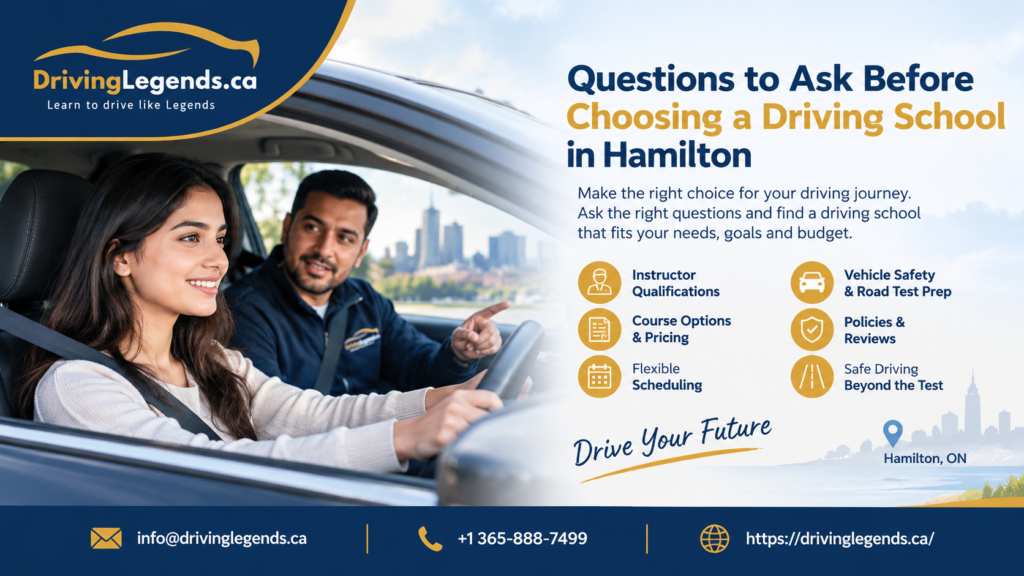
Choosing the right driving school is an important step toward becoming a safe, confident, and responsible driver. For beginners, newcomers to Canada, and drivers preparing for their G2 or G road test, professional driving instruction can help build the skills needed to navigate Ontario roads safely.
With several driving schools available in Hamilton, Ontario, comparing your options before enrolling can help you find a program that suits your learning needs, schedule, and budget. However, choosing a driving school should involve more than comparing prices. Instructor qualifications, lesson structure, vehicle safety, scheduling flexibility, and the quality of instruction are also important factors.
Before making your decision, consider asking the following questions.
1. Is the Driving School MTO-Approved?
One of the first questions to ask is whether the driving school is approved by the Ontario Ministry of Transportation (MTO), particularly if you are interested in taking a Beginner Driver Education (BDE) course.
An approved BDE course follows Ontario’s requirements for driver education and includes classroom or online learning, home study, and in-car instruction. Completing an approved course may also provide benefits such as eligibility for certain insurance discounts, depending on your insurance provider.
Before enrolling, verify the school’s approval status and confirm that the specific course you plan to take is approved. This is especially important if you want your training to be recognized as an official BDE program.
2. Are the Driving Instructors Qualified and Experienced?
The instructor plays a major role in your learning experience. A good instructor should understand Ontario traffic laws, explain driving techniques clearly, and help students develop safe driving habits.
Ask about the instructors’ qualifications, experience, and teaching approach. You may also want to know whether they have experience teaching beginners, newcomers to Canada, nervous drivers, or students preparing for a specific road test.
A supportive instructor should provide constructive feedback, explain mistakes without creating unnecessary stress, and help you improve at a comfortable pace.
3. What Driving Courses and Lessons Are Available?
Driving students have different goals. Some are learning to drive for the first time, while others already have experience but need help preparing for a road test.
Ask whether the school offers the type of training you need, such as:
Beginner driving lessons for new drivers.
Beginner Driver Education (BDE) courses.
G2 road test preparation.
G road test preparation, including highway driving practice.
Refresher lessons for drivers who need additional practice.
Individual lessons for specific skills, such as parking, lane changes, or turning.
Understanding the available options can help you select a program that matches your current ability and driving goals.
4. What Is Included in the Course Price?
Before paying for lessons, ask for a clear breakdown of the total cost. A low advertised price does not always mean the program offers the best value.
Find out how many in-car lessons are included, how long each session lasts, and whether online learning materials or home-study requirements are part of the package.
You should also ask about additional costs, including taxes, payment processing fees, extra lessons, cancellation charges, and vehicle rental for the road test.
If you are comparing several driving schools in Hamilton, make sure you compare similar services. A package with more supervised practice may offer better value than a cheaper option with fewer lessons.
5. How Long Are the In-Car Driving Lessons?
The amount of practical driving time you receive can influence how quickly you develop your skills. Ask how long each lesson lasts and how much of that time is spent actually driving.
For example, a lesson may include vehicle adjustments, a review of previous skills, supervised practice, and feedback at the end. These activities can all be useful, but you should understand what to expect from each session.
It is also worth asking whether lessons are conducted one-on-one or whether other students may be present in the vehicle. Knowing the structure in advance helps you understand how much individual attention you will receive.
6. Can I Choose Lesson Times That Fit My Schedule?
Scheduling is an important consideration, particularly for students balancing school, work, family responsibilities, or other commitments.
Ask whether the driving school offers weekday, evening, or weekend lessons. You should also find out how far in advance lessons need to be booked and whether rescheduling is possible.
If you have a road test approaching, ask whether the school can accommodate your preparation timeline. Booking lessons early can help you maintain a consistent practice schedule without unnecessary interruptions.
7. Will I Practise on Roads Similar to Those Used for My Road Test?
Learning in familiar surroundings can help you become more comfortable with local traffic conditions. When choosing a driving school in Hamilton, ask whether instructors provide practice on a variety of local roads and traffic environments.
Depending on your experience and learning goals, useful practice may include residential streets, busy intersections, lane changes, parking areas, and higher-speed roads.
For G2 preparation, you may need to work on turns, stops, observation, parking, and general vehicle control. For G test preparation, you may need additional practice with highway entry and exit, merging, lane changes, and maintaining safe following distances.
No school can guarantee a passing result, but structured practice and constructive feedback can help you identify areas that need improvement before test day.
8. Does the School Provide a Vehicle for the Road Test?
If you do not have access to a suitable vehicle, ask whether the school offers road test vehicle rental.
Find out whether the service includes only the vehicle or also a warm-up lesson before the test. Ask about pickup arrangements, applicable fees, cancellation policies, and whether the vehicle will be suitable for your test location.
Using a familiar vehicle can make some students feel more comfortable during the examination. If possible, practise in the same vehicle you intend to use for the test so you can become familiar with its controls, mirrors, and handling.
9. What Happens If I Need More Lessons?
Every learner progresses at a different rate. Some students become comfortable with basic driving skills quickly, while others need more time to master parking, observation, traffic awareness, or highway driving.
Ask whether the instructor evaluates your progress and recommends additional practice when necessary. It is also helpful to understand the price of extra lessons and whether you can purchase them individually.
A good learning plan should focus on your actual abilities rather than rushing through lessons. Before scheduling your road test, discuss your strengths and weaknesses with your instructor and identify any skills that still require attention.
10. What Is the Cancellation and Rescheduling Policy?
Unexpected commitments, illness, or changes in availability can affect your lesson schedule. Before enrolling, review the school’s cancellation and rescheduling policy.
Ask how much notice is required to change an appointment and whether a missed lesson results in a fee. You should also check the policy for course withdrawals, refunds, and unused lessons.
Understanding these terms in advance can prevent misunderstandings and help you make an informed decision.
11. What Do Other Students Say About the School?
Reviews and recommendations can provide useful information about a driving school’s teaching quality and customer service.
Look for feedback that discusses instructor communication, punctuality, lesson organization, vehicle condition, scheduling, and the overall learning experience. Reading several recent reviews can help you identify consistent patterns rather than relying on a single comment.
You can also ask friends, relatives, or colleagues about their experiences with local driving schools.
Remember that reviews reflect individual experiences. Consider them alongside the school’s qualifications, course details, policies, and suitability for your needs.
12. Does the School Focus on Safe Driving Beyond the Road Test?
Passing a road test is an important milestone, but learning to drive involves much more than meeting examination requirements.
Ask whether lessons cover defensive driving, hazard awareness, safe following distances, blind-spot checks, appropriate speed selection, and decision-making in changing traffic conditions.
New drivers should also learn how weather, road conditions, distractions, and other road users affect driving decisions. These skills can help you become a more responsible driver after receiving your licence.
A strong driving education program should prepare you not only for your test but also for everyday driving in Hamilton and beyond.
13. Can I Speak With the School Before Enrolling?
A short conversation with the driving school can help you understand its approach and determine whether it is the right fit.
Use this opportunity to explain your experience level, licence stage, goals, and availability. Ask how the school would recommend structuring your lessons and whether there are any requirements you should understand before starting.
Pay attention to how clearly your questions are answered. Transparent communication about prices, scheduling, course requirements, and learning expectations can make the entire process easier.
A Quick Checklist Before Choosing a Driving School
Before making your final decision, use this checklist to compare your options:
Confirm the school’s MTO approval status if you plan to take a BDE course.
Ask about instructor qualifications and teaching experience.
Confirm that the school offers the lessons you need.
Review the complete price and any additional fees.
Check lesson duration and the amount of in-car practice.
Confirm availability for your preferred days and times.
Ask about local road test preparation.
Review road test vehicle rental options, if needed.
Understand cancellation, rescheduling, and refund policies.
Read recent student reviews.
Make sure the training focuses on safe, independent driving.
Choosing the Right Driving School in Hamilton
Selecting a driving school is a personal decision, and the right choice depends on your experience, learning preferences, budget, and goals. Taking time to ask the right questions can help you compare programs carefully and avoid unexpected costs or unsuitable lesson arrangements.
Look beyond the advertised price and consider the overall learning experience. Qualified instructors, clear course information, structured practice, flexible scheduling, and an emphasis on road safety are all important factors to consider.
At Driving Legends Driving School, learners can explore driving education options designed for different stages of their driving journey, including beginner driving lessons, BDE courses, and G2 and G road test preparation. Students can ask questions about available packages, lesson schedules, and training options before deciding which service best meets their needs.
If you are looking for driving lessons in Hamilton, Ontario, contact Driving Legends to learn more about the available programs.
Driving Legends Driving School
Email: info@drivinglegends.ca
Phone: +1 365-888-7499
Website: https://drivinglegends.ca/
Start by asking the right questions, choosing a program that fits your needs, and building the knowledge and practical skills required for safer driving.