
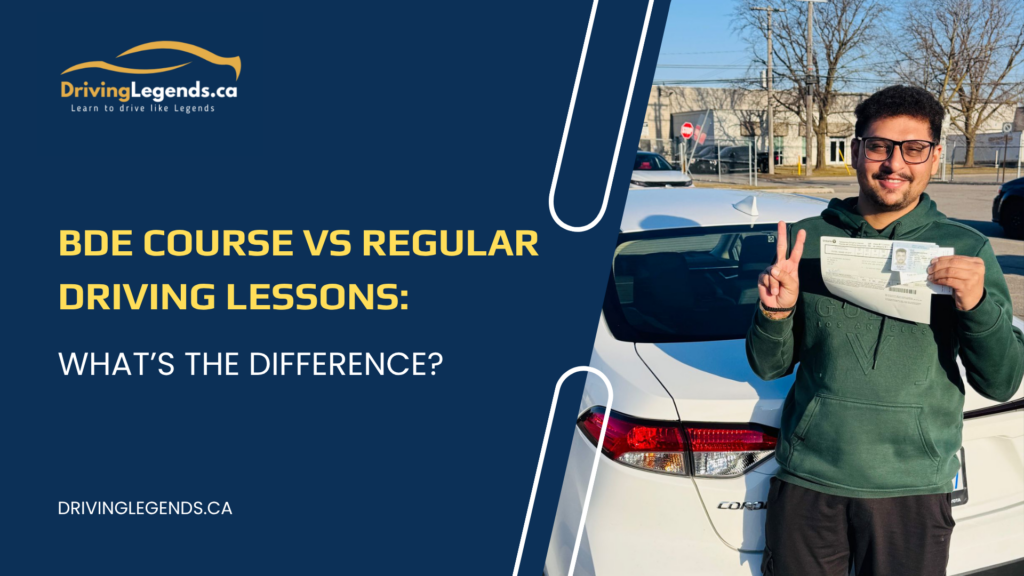
Learning to drive is an important step toward independence, but choosing the right type of training can sometimes be confusing. Many new drivers in Ontario ask the same question: Should I take a BDE course or book regular driving lessons?
Although both options can help you become a safer and more confident driver, they are not the same. A Beginner Driver Education (BDE) course is a structured, Ministry-approved driver education program, while regular driving lessons are generally individual in-car sessions designed around your specific learning needs.
Understanding the difference can help you choose the training that fits your goals, experience, and timeline.
What Is a BDE Course?
BDE stands for Beginner Driver Education. In Ontario, a Ministry-approved BDE program is designed specifically to provide new drivers with structured driver education.
An approved BDE course has a minimum of 40 hours of instruction, including:
- At least 20 hours of classroom or digital instruction
- At least 10 hours of in-vehicle training
- 10 hours of flexible instruction, which can include additional classroom, digital, in-car, simulator, or home-study learning
The program combines driving knowledge with practical experience rather than focusing only on time behind the wheel.
BDE programs are particularly useful for new drivers who want a complete introduction to driving rather than only a few practical lessons.
What Are Regular Driving Lessons?
Regular driving lessons are usually one-on-one in-car sessions with a professional driving instructor.
Instead of following the full structure of a BDE program, lessons can be focused on the areas where you need the most practice.
For example, a learner may book driving lessons to work on:
- Basic vehicle control
- Turning and stopping
- Parking
- Lane changes
- Mirror and shoulder checks
- City driving
- Highway driving
- Defensive driving
- G2 road test preparation
- G road test preparation
- Building confidence behind the wheel
At Driving Legends, individual driving lessons are designed around the learner’s experience and goals, including beginner training, road-test preparation and additional practice.
BDE Course vs Regular Driving Lessons
Here is a simple comparison:
|
Feature
|
BDE Course
|
Regular Driving Lessons
|
|---|---|---|
|
Program structure
|
Structured course
|
Individual sessions
|
|
Classroom/digital learning
|
Yes
|
Usually no
|
|
In-car training
|
Included
|
Main focus
|
|
Flexible learning
|
Included
|
Depends on lesson provider
|
|
Beginner-focused
|
Yes
|
Can be for beginners or experienced drivers
|
|
Road-test preparation
|
Included as part of training
|
Can be specifically focused on the test
|
|
Best suited for
|
New drivers seeking complete training
|
Drivers needing specific or additional practice
|
1. Difference in Course Structure
The biggest difference is the overall structure.
A BDE course follows an approved curriculum and combines theory, practical driving and flexible learning. Ontario requires approved BDE programs to meet specific training-hour and curriculum requirements.
Regular driving lessons are much more flexible. You can book individual sessions based on your availability and concentrate on particular skills.
For example, if you already know how to operate a vehicle but struggle with parallel parking, you may not need a complete beginner course. A focused driving lesson can be used specifically to improve your parking technique.
2. Difference in Classroom and Online Learning
A BDE course includes a significant knowledge and education component.
Students learn about topics such as:
- Ontario traffic laws
- Road signs
- Defensive driving
- Driver responsibilities
- Risk awareness
- Hazard recognition
- Safe driving decisions
- Highway and adverse-condition driving
The Ontario government requires approved BDE programs to include at least 20 hours of classroom or digital instruction.
Regular driving lessons generally concentrate on practical, behind-the-wheel training.
This makes regular lessons useful when your primary goal is practical driving practice rather than completing a complete driver education program.
3. Difference in In-Car Training
Both options can include practical driving experience, but the way it is organized is different.
An approved BDE course must include at least 10 hours of in-vehicle instruction.
Regular lessons are primarily focused on in-car instruction. You can decide how many sessions you need based on your experience and progress.
For example:
A beginner might focus on:
- Starting and stopping
- Steering
- Turns
- Intersections
- Basic parking
- Lane positioning
An experienced G2 driver might focus on:
- Highway merging
- Lane changes
- Following distance
- Speed control
- Defensive driving
- G test preparation
This flexibility can make regular lessons useful for learners who already have some driving experience.
4. G1 to G2 Timeline
One important benefit of completing an approved BDE course is that it can reduce the minimum time a new driver must spend at the G1 level.
Ontario’s graduated licensing rules normally require a new driver to spend 12 months at the G1 level. Successfully completing a Ministry-approved driver education course can reduce that minimum period to 245 days, or approximately eight months.
Regular driving lessons by themselves do not provide this specific BDE certification benefit.
This is one reason new G1 drivers may consider an approved BDE program when planning their licensing journey.
5. Potential Insurance Benefits
Completing an approved BDE course may also make you eligible for an insurance discount.
However, the amount and availability of any discount depends on the insurance company. Ontario specifically notes that completing a BDE course does not guarantee an insurance discount, so students should contact their insurer for details.
Regular driving lessons do not automatically provide the same BDE certification.
6. Which Option Is Better for a Complete Beginner?
For someone who has never driven before, a structured BDE program can provide a broader learning experience because it combines driving theory with practical training.
You learn not only how to control the vehicle, but also why certain driving decisions are safer.
For example, a complete beginner needs to understand:
- How to scan the road
- How to recognize hazards
- How to maintain safe following distance
- How to respond to changing traffic
- How to communicate with other road users
- How to make safer driving decisions
A combination of structured education and practical driving can help establish good habits from the beginning.
7. When Are Regular Driving Lessons Useful?
Regular driving lessons can be useful in many different situations.
You already completed a BDE course
You may want additional practice before your G2 or G road test.
You have a foreign driving licence
Newcomers may already have driving experience but need help adapting to Ontario traffic rules and driving conditions.
You are nervous behind the wheel
One-on-one instruction can allow you to work gradually on the areas that make you uncomfortable.
You need G2 road test preparation
Lessons can focus on parking, lane changes, turns, intersections and other skills relevant to your preparation.
You are preparing for your G test
You can focus on highway driving, merging, lane changes, speed management, observation and defensive driving.
You want a refresher
Experienced drivers may book individual lessons when they want to rebuild confidence or improve particular driving habits.
Can You Take Both a BDE Course and Regular Driving Lessons?
Yes.
The two options do not have to be treated as alternatives.
A learner can complete an approved BDE program and then take additional individual lessons when needed.
For example:
Step 1: Complete your G1 knowledge test
Step 2: Enrol in an approved BDE course
Step 3: Complete classroom/digital and in-car training
Step 4: Continue supervised practice
Step 5: Take additional G2 preparation lessons if required
Step 6: Prepare for your road test
Additional lessons can be especially useful when you have identified specific skills that need more practice.
BDE Course or Regular Lessons: What Should You Consider?
Before choosing your training, think about your current situation.
Choose a BDE course if:
- You are a new driver
- You want structured driver education
- You want both theory and practical training
- You want to learn Ontario driving rules in a systematic way
- You want to become eligible for the BDE-related G1 wait-time reduction
- You want to ask your insurer about a possible BDE discount
Consider regular driving lessons if:
- You need additional in-car practice
- You already have driving experience
- You want help with specific skills
- You are preparing for a G2 road test
- You are preparing for a G road test
- You want highway-driving practice
- You want to improve confidence behind the wheel
What Does Driving Legends Offer?
At Driving Legends, learners can access both structured BDE training and personalized driving lessons in Hamilton.
The school’s BDE packages currently combine the BDE course with online learning, home-study links and in-car training. Individual lessons are also available for learners who want one-on-one instruction at their own pace.
Training can cover areas such as:
- Beginner driving
- Vehicle control
- Parking
- Lane changes
- City driving
- Defensive driving
- G2 road test preparation
- G road test preparation
- Highway driving
- Mock road-test practice
The goal is to help learners develop practical driving skills and confidence for both their road test and everyday driving.
Final Thoughts
The main difference between a BDE Course and regular driving lessons is the structure and purpose of the training.
A Ministry-approved BDE course is a comprehensive driver education program combining classroom or digital learning, in-car instruction and flexible training. It can also provide eligible graduates with a reduced G1 waiting period and may provide an opportunity for an insurance discount.
Regular driving lessons are more flexible and can be tailored to the specific skills a learner wants to improve.
For many new drivers, completing a BDE course and then using additional individual lessons for extra practice can be a practical way to continue developing driving skills.
Ready to start learning to drive in Hamilton? Driving Legends provides beginner driving lessons, BDE training, G2 preparation and G driving lessons with personalized instruction.
Contact Driving Legends today to learn more about your driving training options.