
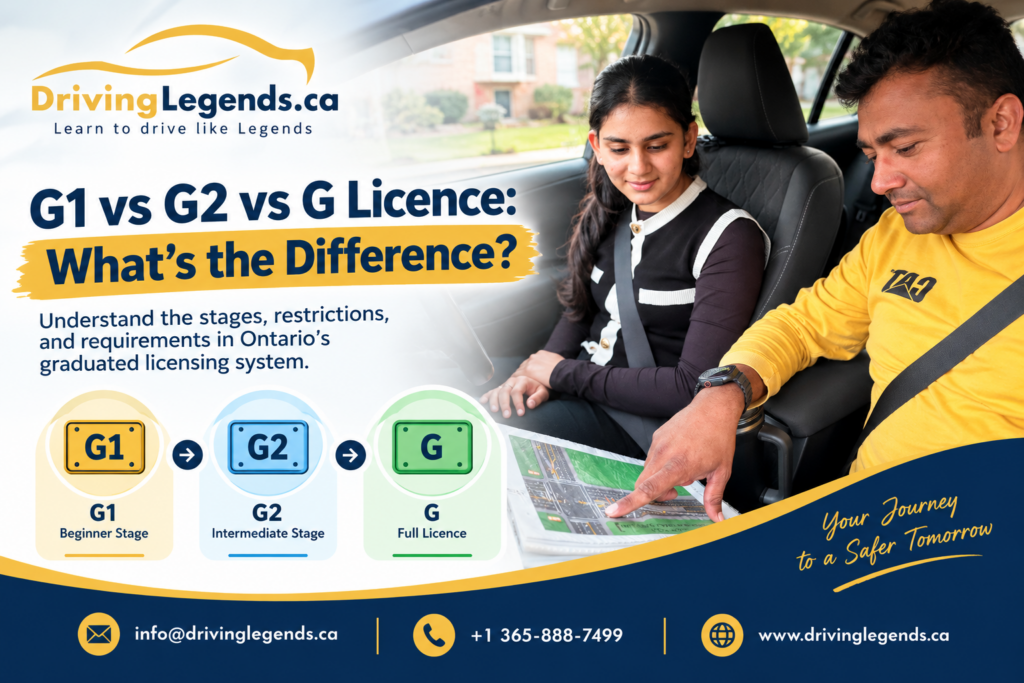
Getting a driver’s licence is an important milestone for anyone who wants to become more independent on the road. In Ontario, new drivers generally progress through a graduated licensing system that includes three stages: G1, G2, and G. Each stage comes with different driving privileges, restrictions, and responsibilities.
Understanding the differences between these licences can help new drivers prepare for their next test, develop safe driving habits, and know what to expect at every stage of the process.
In this guide, we explain the differences between G1, G2, and G licences in Ontario, including their requirements, restrictions, and testing procedures.
What Is Ontario’s Graduated Licensing System?
Ontario uses a graduated licensing system to help new drivers gain experience gradually before receiving full driving privileges. Instead of moving directly from a beginner’s permit to a full licence, drivers progress through different stages as they develop their knowledge and practical driving skills.
The three main stages are:
G1 Licence: The beginner stage, which allows driving only under specific conditions.
G2 Licence: The intermediate stage, which provides greater independence with some restrictions.
G Licence: The full licence, which offers the broadest driving privileges for regular passenger vehicles.
Each stage is designed to help drivers gain experience, understand traffic laws, and learn how to handle different road conditions safely.
1. What Is a G1 Licence?
A G1 licence is the first stage of Ontario’s graduated licensing system. It is generally available to new drivers who are at least 16 years old and have passed the required vision screening and written knowledge test.
The knowledge test covers road signs, traffic signals, and the rules of the road. Once a driver receives a G1 licence, they can begin practising their driving skills under the required supervision.
G1 Licence Requirements
To obtain a G1 licence, applicants generally need to:
Be at least 16 years old.
Pass a vision test.
Pass the written knowledge test on traffic rules and road signs.
Provide the required identification and documentation.
G1 Licence Restrictions
G1 drivers must follow several important restrictions:
They must drive with a qualified accompanying driver who holds a valid full G licence and meets Ontario’s experience requirements.
Their accompanying driver must generally have at least four years of driving experience, with the applicable conditions for calculating that experience.
They must maintain a zero blood alcohol concentration.
They cannot drive on certain 400-series highways and high-speed expressways unless accompanied by a qualified driving instructor, subject to Ontario’s rules.
They must not drive between midnight and 5 a.m.
G1 drivers must also ensure that the accompanying driver sits in the front passenger seat and is able to supervise their driving.
How Long Must You Hold a G1 Licence?
Most drivers must hold their G1 licence for at least 12 months before taking the G2 road test. However, completing an approved beginner driver education course can reduce this waiting period to eight months.
The G1 stage provides an opportunity to practise essential skills such as steering, braking, turning, lane positioning, observation, and following traffic signs.
2. What Is a G2 Licence?
A G2 licence is the second stage of Ontario’s graduated licensing system. Drivers can obtain it after holding a G1 licence for the required period and passing the G2 road test.
Unlike G1 drivers, G2 drivers can generally drive independently without a supervising driver. This stage allows new drivers to build confidence and experience in everyday driving situations.
G2 Licence Requirements
To obtain a G2 licence, drivers must:
Hold a valid G1 licence for the required waiting period.
Pass the G2 road test.
Meet the applicable licensing requirements.
The G2 road test evaluates practical driving skills, including turns, lane changes, intersections, observation, speed management, and other essential manoeuvres.
G2 Licence Restrictions
Although G2 drivers have more freedom than G1 drivers, some restrictions still apply.
Alcohol and drugs: G2 drivers must maintain a zero blood alcohol concentration and comply with applicable drug-related driving laws.
Passenger restrictions for young drivers: Drivers aged 19 or younger face additional passenger restrictions during the first six months of holding a G2 licence. During the restricted late-night hours, they may carry only one passenger aged 19 or younger, subject to the applicable exceptions. After the first six months, the limit generally increases to three such passengers until they turn 20. Exceptions apply in certain circumstances, including when a qualified accompanying driver is present or when the passengers are immediate family members.
Insurance: G2 drivers must have appropriate vehicle insurance when required to drive a vehicle. Insurance costs may vary based on driving experience, age, location, vehicle type, and the insurer.
G2 drivers must also follow all regular traffic laws, including speed limits, seat belt requirements, and distracted driving regulations.
How Long Must You Hold a G2 Licence?
Most drivers must hold their G2 licence for at least 12 months before attempting the full G road test.
The G2 stage is an important period for practising independently, driving in different traffic conditions, improving hazard awareness, and preparing for the final road test.
3. What Is a G Licence?
A G licence is Ontario’s full licence for most regular passenger vehicles. It is the final stage of the graduated licensing system.
Drivers who obtain a G licence have completed the required licensing stages and passed the applicable road test. They can generally drive independently without the G1 and G2 graduated licensing restrictions.
G Licence Requirements
To qualify for a G licence, drivers generally need to:
Hold a valid G2 licence for at least 12 months.
Pass the full G road test.
Meet the applicable licensing requirements.
Ontario’s licensing rules may provide different pathways or requirements for drivers with qualifying previous driving experience. Applicants should confirm their eligibility with the Ministry of Transportation of Ontario.
Benefits of a G Licence
A full G licence provides greater driving independence and removes the specific restrictions associated with the G1 and G2 stages.
Some key benefits include:
Driving independently without a supervising driver.
No G1-style midnight-to-5 a.m. driving restriction.
No G2 graduated-licensing passenger limits for young drivers.
Greater flexibility for commuting, work, school, and travel.
However, a G licence does not remove the responsibility to obey traffic laws. Drivers must continue to follow speed limits, avoid impaired and distracted driving, maintain required insurance, and drive according to road and weather conditions.
A full G licence also does not authorize every type of vehicle. Different licences and endorsements may be required for commercial vehicles, motorcycles, buses, or other vehicle categories.
G1 vs G2 vs G Licence: Key Differences
The following table summarises the main differences between the three licence stages.
| Feature | G1 Licence | G2 Licence | G Licence |
|---|---|---|---|
| Stage | Beginner | Intermediate | Full licence |
| Written knowledge test | Required | Already completed at G1 stage | Already completed at G1 stage |
| Road test | Not yet completed | G2 road test required | Full G road test required |
| Supervising driver | Required | Not generally required | Not required |
| Driving between midnight and 5 a.m. | Not permitted | Generally permitted, subject to applicable laws | Permitted, subject to applicable laws |
| Zero blood alcohol requirement | Yes | Yes | General novice-driver zero-alcohol rule no longer applies solely because of licence stage; other restrictions may apply |
| Special passenger restrictions for young drivers | Supervision rules apply | Yes, during the applicable period | No G2 graduated-licensing passenger limits |
| Full driving privileges | No | No | Yes, for vehicles covered by the licence |
How Long Does It Take to Get a Full G Licence in Ontario?
For a new driver following the standard graduated licensing process, the minimum timeline is generally:
Without an approved beginner driver education course:
G1 stage: At least 12 months.
G2 stage: At least 12 months.
Total: Approximately 24 months before becoming eligible for the full G road test.
With an approved beginner driver education course:
G1 stage: At least eight months.
G2 stage: At least 12 months.
Total: Approximately 20 months before becoming eligible for the full G road test.
These timelines assume the driver passes each required test on the first attempt and meets all eligibility requirements. Booking availability, test results, licence expiry dates, and individual circumstances can affect the actual timeline.
Tips for Progressing from G1 to G2 to G
Moving through Ontario’s licensing stages requires more than passing tests. Consistent practice and safe driving habits are essential.
1. Practise Regularly
G1 drivers should practise with a qualified accompanying driver in a variety of traffic conditions. Repetition helps develop better vehicle control, observation, and decision-making skills.
2. Learn Defensive Driving
Pay attention to other road users, maintain a safe following distance, check blind spots, and anticipate possible hazards. Defensive driving skills are useful throughout every licensing stage.
3. Understand Road Signs and Traffic Rules
Knowing road signs, right-of-way rules, speed limits, and intersection procedures helps drivers make safer decisions and prepare for knowledge and road tests.
4. Practise Essential Road Test Skills
Before a road test, practise lane changes, turns, parking, merging, intersections, speed control, and observation techniques. For the full G test, practise highway driving and entering and exiting highways safely.
5. Consider Professional Driving Lessons
Professional instruction can help new drivers identify areas for improvement and develop good driving habits. Lessons can also help drivers become familiar with common road test expectations and practise skills they find challenging.
Conclusion
Understanding the differences between G1, G2, and G licences helps new drivers plan their learning journey and prepare for each stage of Ontario’s graduated licensing system.
The G1 stage focuses on supervised practice, the G2 stage provides greater independence with certain restrictions, and the full G licence offers the broadest driving privileges for regular passenger vehicles.
By practising consistently, learning defensive driving techniques, and preparing carefully for each road test, drivers can develop the knowledge and confidence needed to drive safely.
For drivers in Hamilton and surrounding communities, professional driving instruction can provide additional guidance throughout the learning process. The goal is not simply to pass a road test, but to become a responsible driver who makes safe decisions every time they get behind the wheel.
Frequently Asked Questions
Can I drive alone with a G1 licence?
No. G1 drivers must be accompanied by a qualified supervising driver who meets Ontario’s requirements. They must also follow all other G1 restrictions.
Can I drive alone with a G2 licence?
Yes. G2 drivers can generally drive alone, provided they follow applicable laws and any restrictions related to their licence stage, age, and circumstances.
Is the G2 road test harder than the G1 test?
The G1 test is a written knowledge test, while the G2 test is a practical road test. They assess different skills. The G2 test evaluates a driver’s ability to operate a vehicle safely in real traffic situations.
Can I skip the G2 stage and go directly to a G licence?
Most new drivers must complete the graduated licensing stages. However, drivers with qualifying previous driving experience may be eligible for credit or different licensing arrangements. Check with the Ministry of Transportation of Ontario for your specific situation.
Does completing a BDE course help me get my G licence faster?
An approved beginner driver education course can reduce the minimum G1 waiting period from 12 months to eight months. It does not generally eliminate the required 12-month G2 waiting period.
What happens if my G2 licence expires?
Licence expiry rules and renewal options depend on your circumstances. Drivers should check their licence expiry date and contact ServiceOntario or the Ministry of Transportation of Ontario well in advance to understand their available options.